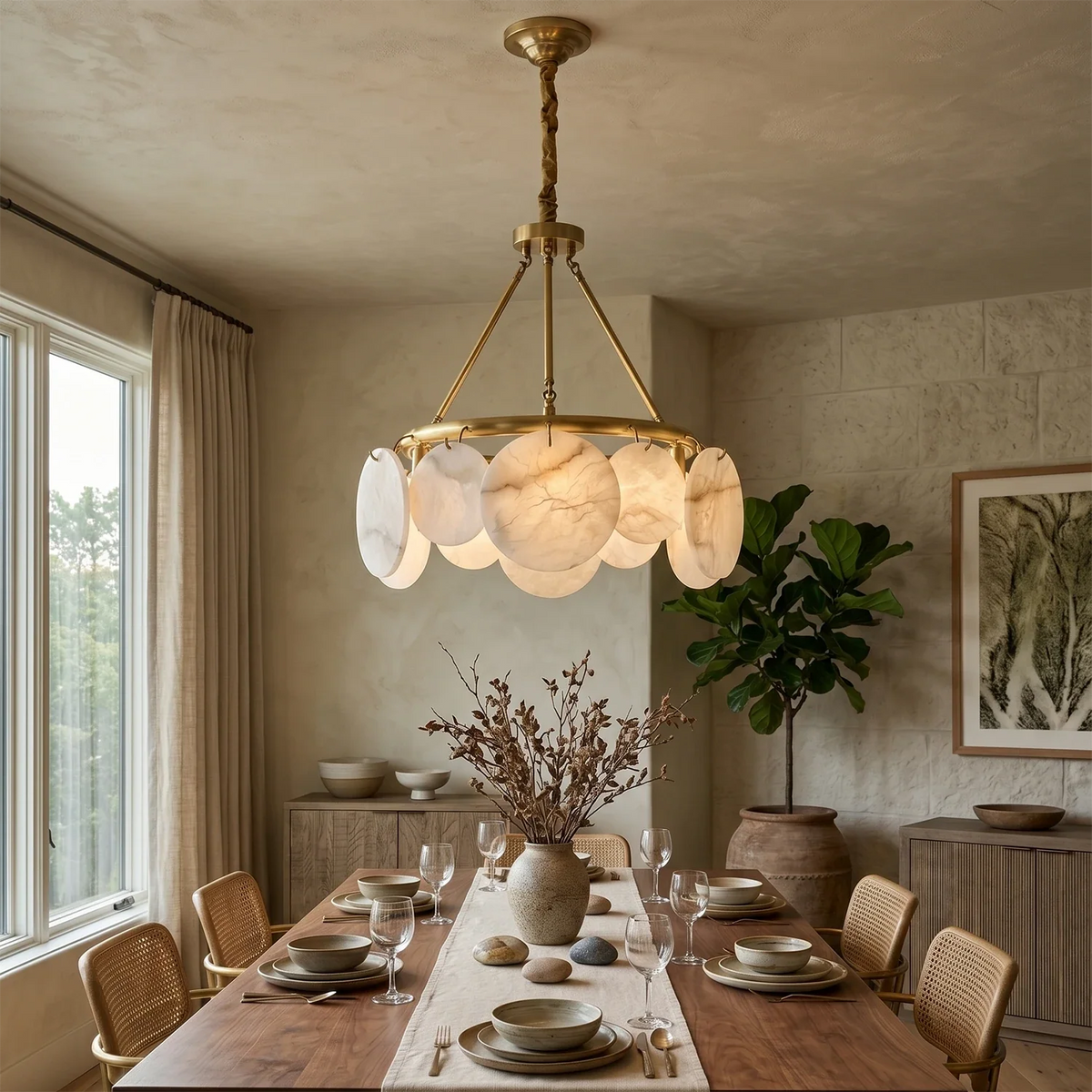
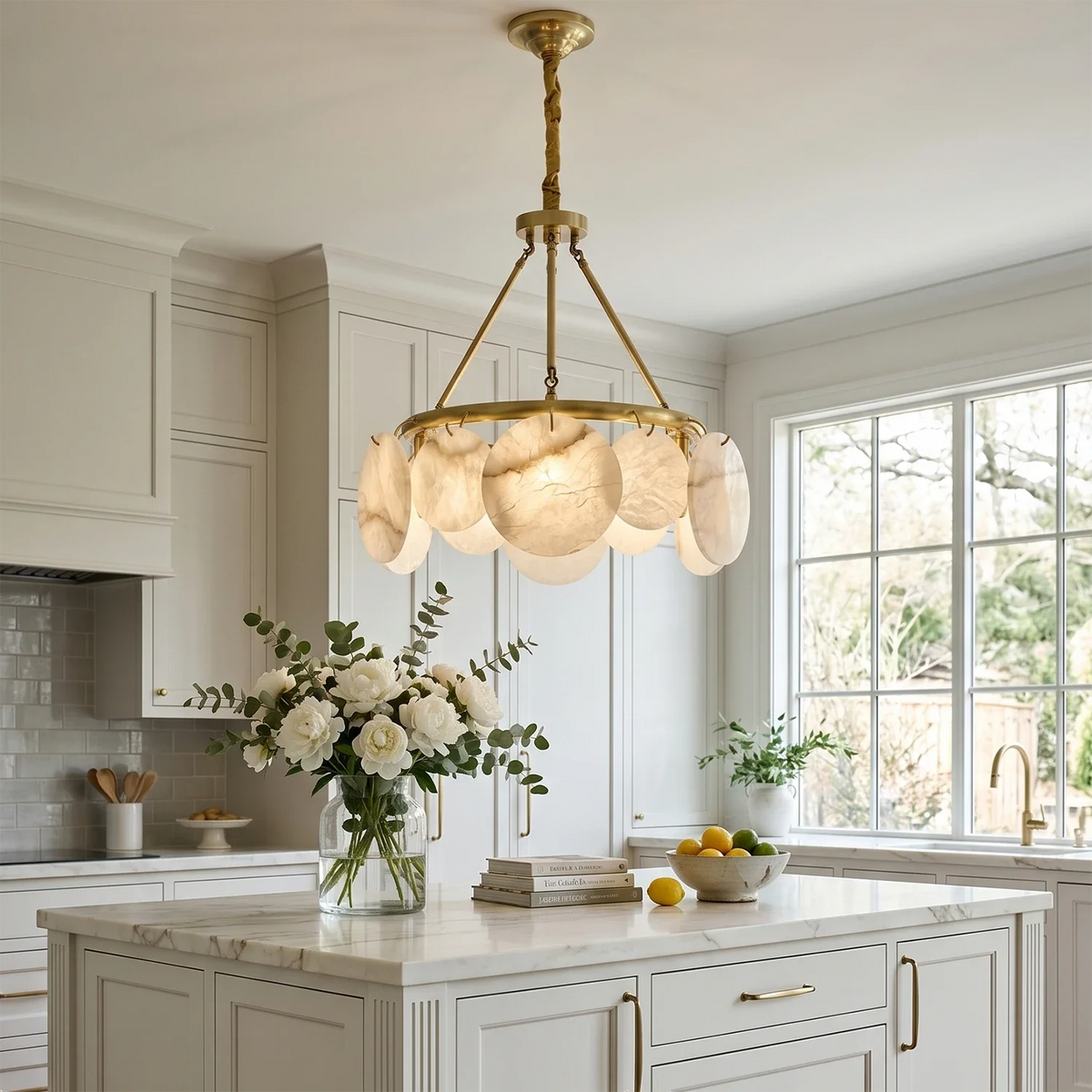
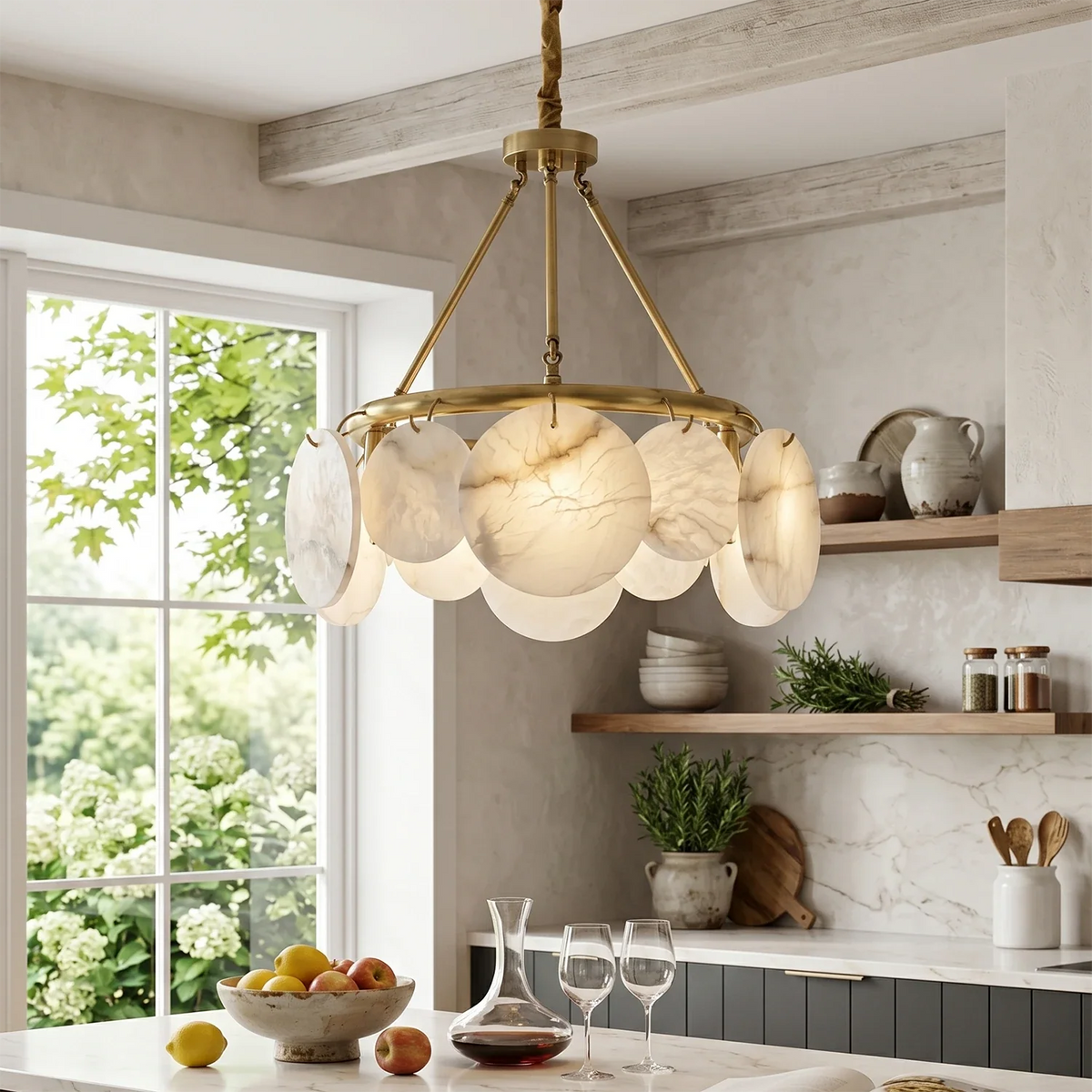
The Alba Natural Alabaster Disc Chandelier seamlessly blends timeless luxury with a delicate, contemporary silhouette, featuring a premium stone assembly that radiates a soft, filtered ambient glow. Inspired by the organic layering of delicate sea shells, each chandelier is inherently unique, boasting rich, naturally formed natural alabaster veining that transforms into a mesmerizing, luminous sculpture when illuminated.
Suspended by an elegant, texture-accented stem and framed in an ultra-refined brushed brass hoop, this layered, overlapping disc fixture is perfect for grand foyers, transitional dining rooms, and tailored master suites, adding an effortless "quiet luxury" touch to any high-end interior.
Why the Alba Alabaster Series Stands Out
100% Genuine Translucent Alabaster: No two discs are identical. The naturally veined, cream-toned stone masterfully diffuses harsh bulb light into a glare-free, ethereal radiance, instantly injecting a museum-quality, boutique-hotel aesthetic into your home.
Shell-Inspired Sculptural Silhouette: The interlocking, overlapping round panels create a rhythmic, tiered layer that mimics organic coastal forms. It beautifully balances raw, geological texturing with clean, sleek, and warm-toned modern metal lines.
◎
Natural Stone Variation
Alabaster patterns vary from piece to piece — the stone you receive will differ from the one pictured. Each piece with natural textures is unique.
Why This One
Stone Laid Like Overlapping Shells
◆
01
Every Disc Cut From a Different Block
Natural alabaster is quarried and sliced, not poured into a mould. The cloudy grey and amber banding runs differently through every disc on your fixture, and differently again from the one in these photographs. A moulded shade repeats one pattern on every unit it ever produces; stone cannot.
02
Discs That Overlap Rather Than Line Up
The round panels are staggered so each one laps over its neighbour, the way shells settle against each other on a shoreline. That overlap is what gives the fixture depth from below — you read layers rather than a single flat ring, and the silhouette shifts as you cross the room.
03
Light Through the Stone, Not Around It
The bulbs sit behind the discs, so what reaches the room has travelled through the material and picked up its grain on the way. Thin passages run bright, dense ones hold back, and where two discs overlap the stone doubles in thickness and deepens to amber.
04
A Brass Hoop Holding It Together
Every disc hangs from a single brushed brass ring, so the whole arrangement reads as one object rather than a cluster of separate shades. Warm metal against pale stone is also what keeps the fixture from disappearing into a white ceiling when it is switched off.
Quarried alabaster on a brushed brass frame — veining differs from disc to disc and from piece to piece
Specifications
Features & Details
Features
Material
Natural alabaster discs, brass frame
Finish
Brushed brass frame with white alabaster discs · one combination
Stone
Quarried alabaster, cream-white ground · veining runs grey to amber and differs on every disc
Light Source
E14 base — 5, 6, 8 or 10 lamps depending on size · bulbs not included
Power
Max 40W per bulb · LED recommended, particularly on the 8- and 10-lamp sizes
Mounting
Ceiling mounted — hardwired, installation by a qualified electrician recommended · suits flat and sloped ceilings
IP Rating
IP20 · indoor dry locations only · not waterproof
Dimming
Depends on the bulb — fit dimmable E14 lamps and a compatible wall dimmer
Style
Organic modern · California casual · Modern transitional · Mid-century modern · Modern minimalist
Application
Dining room · Bedroom · Entryway · Foyer · Living room · Study (indoor dry locations only)
Specification
Voltage
AC 110V–240V compatible
Power Type
Hardwired to a ceiling junction box — no plug supplied
Control
Operates from your existing wall switch
Certification
UL · CE · SAA
Warranty
2-year manufacturer warranty
Caring for natural stone and brass: dust the discs with a dry, soft cloth or a static duster, supporting each one from behind as you work. Never use water, a damp cloth, glass cleaner, vinegar or anything abrasive on the stone — alabaster is porous and softer than glass, so liquids soak in and the marks do not come back out. The brass frame needs dry dusting only; skip metal polish, which will cut through the finish. Switch the fixture off at the wall and let the bulbs cool before cleaning, and keep it out of bathrooms and away from cooking steam.
Find Your Size
Four Sizes, From Bedside to Foyer
The largest is more than twice the diameter of the smallest and carries twice the bulbs. These are not four versions of one fixture — they belong in genuinely different rooms.
5 Head
∅ 17.72″
× H 17.72″
Bulbs
5 × E14
Room up to
11 × 11 ft
Ceiling
8–9 ft
Over a table
30–34″
A bedside, a small entry, a study, or a round breakfast table for two. Present without taking over the ceiling.
6 Head · Most Chosen
∅ 23.62″
× H 20.47″
Bulbs
6 × E14
Room
11–15 ft
Ceiling
9–10 ft
Over a table
30–36″
A dining table seating four to six, a mid-size living room, or a primary bedroom where the fixture should be the thing you notice.
8 Head
∅ 31.5″
× H 22.05″
Bulbs
8 × E14
Room
15–18 ft
Ceiling
10 ft or more
Over a table
32–36″
A long dining table seating six to eight, a double-height entry, or an open-plan room that wants one anchor rather than several small fixtures.
10 Head
∅ 39.37″
× H 23.62″
Bulbs
10 × E14
Room from
18 ft up
Ceiling
11 ft or more
Over a table
34–36″
A grand foyer, a staircase void, or a banquet-length table. At over three feet across this is architecture rather than a light fitting — it needs volume around it.
Overall drop runs from 17.72″ on the 5 head to 23.62″ on the 10 head
Sizing to the Room
Add the room's length and width in feet and read that number as inches — a 12 × 14 ft room lands around 26″, so the 6 head suits it. Ceiling height matters as much as floor area: this fixture drops 17–24″ depending on size, so a low ceiling rules out the larger two.
Sizing to a Table
Over a dining table, ignore the room and size to the table. The fixture should be roughly half to two-thirds the width of the tabletop and never wider than the table itself — the 39.37″ needs a table at least five feet wide.
Bulbs and Output
Each size carries its own count: 5, 6, 8 or 10 E14 lamps, 40W maximum each, sold separately. Stone diffuses light rather than projecting it, so even the largest reads as a warm ambient glow — plan on recessed downlights alongside it if the room needs task-level brightness. LED keeps heat away from the stone.
Sloped Ceilings
The interlocking loop chain lets the fixture hang plumb on a flat or a vaulted ceiling. On a slope, confirm the canopy angle with your electrician before ordering the larger sizes.
Before you order: this is a hardwired fixture built from solid stone, and the larger sizes are considerably heavier than a glass or acrylic equivalent of the same diameter. Check that your ceiling junction box is rated for a heavy fixture and fixed to a joist rather than to drywall alone. If you are unsure, ask the electrician who will install it before choosing a size rather than after it arrives.
Off and On
The Stone Keeps Its Grain Hidden Until You Switch It On
Unlit, alabaster is a quiet cream-white and gives away almost nothing. Everything that makes it worth cutting from stone rather than moulding from resin only appears once there is light behind it. Same fixture, same camera position, one switch.
Unlit
A Sculpture in Pale Stone
Switched off, the discs read as flat cream-white plates with soft shadows where they overlap, and the brass hoop is what holds your eye. This is how the fixture spends most of the day — which is why the stone is polished on both faces rather than only the one you see lit.
Lit
Grain Rising Through Every Disc
Light travels through the material instead of off it, so the cloudy bands inside each block surface at once and the whole fixture turns honey-toned. Where two discs overlap the stone doubles in thickness and reads deeper — that is the layering doing its work. Compare the two images above at the same disc: what looks like plain white plate is carrying grey and amber banding that only daylight was hiding.
Why Your Discs Won't Match Each Other
Worth saying plainly, because it shows up most once the lamp is on: the discs on a single fixture are cut from different blocks and will not match one another. One may run cooler and greyer, its neighbour warmer and more amber. That is not a sorting error — it is what quarried stone does, and it is the reason the fixture looks like an assembly of natural pieces rather than a set of matched panels.
How Far the Light Reaches
Stone diffuses light rather than projecting it, so this is a warm ambient glow, not task lighting — even on the 10-head size. It sets the atmosphere of a dining room or foyer beautifully; pair it with recessed downlights if you need to read or work under it.
Choosing the Bulbs
E14 lamps, 40W maximum each, sold separately — 5, 6, 8 or 10 depending on size. A warm white around 2700K is what these photographs use and what turns the stone gold. At 4000K or above, alabaster goes flat and grey and the veining stops reading. Use the same bulb in every socket: one cooler lamp among warm ones is obvious through translucent stone.
Photographed with warm white bulbs — tone and veining will read differently with the bulbs you fit
About the Stone
No Two Discs Match — Not Even on the Same Fixture
This is the one thing worth understanding before you order. A single Alba carries five to ten alabaster discs, and every one of them was cut from a different part of the quarry. They will not match each other, and they will not match these photographs. That is the material, not a fault in it.
Alabaster forms in beds over a long stretch of time, and each layer traps something slightly different — more iron here, more clay there, a denser band where the water ran slower. When a block is quarried and sliced into discs, that history gets cut across at whatever angle the saw happens to take. One disc comes out cool and grey, the next warm and amber, and neither of them looks like the one in a photograph shot two months earlier from a different block.
A moulded resin panel repeats one pattern on every unit it ever produces, because it comes out of the same tool. That is the trade you are making: consistency, or a material that was doing something for several thousand years before anyone cut a lamp out of it.
What Stays the Same
The Things You Are Buying For
● Disc diameter, thickness and overall dimensions
● The cream-white ground colour unlit
● The warm honey tone once the bulbs are on
● The polished surface on both faces of every disc
● The brushed brass frame and how the discs sit on it
What Will Differ
Disc to Disc, and Piece to Piece
● Where the cloudy bands sit and which way they run
● How far each disc leans toward grey or toward amber
● The number and size of darker mineral flecks
● Which passages run bright when lit and which hold back
● How one disc reads against the one overlapping it
Marks That Are Not Faults
Fine surface lines, small translucent patches, faint colour banding and darker mineral flecks appear in every piece of natural alabaster and become far more visible once the fixture is lit. So does the difference between one disc and its neighbour. None of these is damage — they are the reason the material costs what it does.
What Is a Fault
A chip on a rim, a crack running through a disc, a disc that arrives in more than one piece, or a missing part. Those are transit or quality issues rather than variation — photograph the packaging as well as the fixture and contact us, and we will send replacement discs.
If You Want Them Closer
Some people prefer a fixture where the discs sit closer in tone; others want the full range on show. Tell us at checkout which you would rather have and we will select accordingly from what is in stock — though on a natural material this is a preference we work toward, not a specification we can guarantee.
Ordering More Than One Fixture
Two Albas ordered together will not be a matched pair, and neither will a chandelier ordered alongside a wall sconce from the same series. Expect the same cream ground and the same warm glow; expect the veining to differ throughout.
Quarried, cut and polished — one block, one disc, no repeats
Care & Cleaning
Dry Cloth, Both Materials, No Exceptions
Porous stone and a coated brass finish happen to want exactly the same treatment, which makes this simple: nothing wet, nothing abrasive, ever. Two or three minutes of dusting once or twice a year is the whole job.
The Discs
Natural Alabaster
Alabaster is a soft, porous stone — softer than glass, and soft enough that a fingernail can mark it. Anything liquid soaks into the surface rather than sitting on it, which is why a water spot does not dry out and disappear; it dries darker than the stone around it and stays.
Dry, soft cloth or a static duster only. No water, no damp cloths, no glass cleaner, no vinegar, nothing abrasive.
The Frame
Brushed Brass
The satin finish is protected by a thin coating that keeps the brass from oxidising. That coating is what you are looking after — it handles fingerprints and dust perfectly well on its own, but it is thin enough that polish cuts through it and exposes bare metal that will then tarnish unevenly.
Dry microfiber only. No metal polish, no scouring pad, no all-purpose spray — polish is the one product that will damage this finish.
How to Dust It Without Loosening a Disc
Before You Start
Switch off at the wall and let the bulbs cool completely. On the larger sizes that means giving it a good twenty minutes — the sockets sit close behind the stone. Work from a stable step ladder with both hands free, not from a chair.
One Disc at a Time
Support each disc from behind with your free hand while you wipe the face, and move across it rather than pressing into it. The discs hang from the hoop rather than being fixed rigid, so sideways pressure works the mounting loose over time — and stone that comes free from a ceiling fixture does not survive the floor.
Where the Dust Actually Sits
On the upper faces and in the shadow where two discs overlap — not on the visible undersides. A soft dry brush reaches into the overlaps better than a cloth. This matters more than it sounds: dust sitting on translucent stone shows up as grey patches the moment the fixture is lit.
If Something Marks the Stone
Lift dry dust or dry dirt off with the cloth and stop there. Do not damp-blot it. Blotting turns a small mark into a permanent ring roughly twice the size, because the moisture carries the dirt into the pores and then dries darker. Grease and liquid cannot be removed from this material — contact us about a replacement disc rather than attempting it.
Where Not to Hang It
Not a bathroom, and not directly above a cooktop. This fixture is rated IP20, and porous stone takes up humidity and airborne cooking grease long before you would notice a mark. A dining room, a foyer, a bedroom or a living room is where it belongs.
Bulbs and Heat
Stay within 40W per lamp, and use LED where you can. On the 8- and 10-head sizes that is eight or ten heat sources sitting close behind stone; LED runs cool enough that the question does not arise, and it also keeps the brass coating out of a warm environment.
How Often
Twice a year is enough in most homes, once a year in a low-traffic room. Neither material needs treating, sealing, waxing or polishing, and there is no maintenance product you should be buying for it.
Porous quarried stone and a coated brass frame — both want the same thing, which is to be left dry
Questions, Answered
Alabaster Disc Chandelier FAQ
Why don't the discs on my chandelier match each other?
Because each one was cut from a different part of the quarry. A single Alba carries five to ten discs, and they are not sorted to match. One may run cool and grey, its neighbour warm and amber — and the difference shows up far more once the fixture is lit. This is not a packing error. A moulded shade repeats one pattern on every unit it ever produces because it comes out of the same tool; stone cannot, and that is the reason to buy it.
Is it bright enough to be the only light in the room?
It depends what you do in that room. Stone diffuses light rather than projecting it, so even the 10-head size gives a warm ambient glow rather than task-level brightness. Over a dining table, a bed or in a foyer that is exactly right. If you read, cook or work in the same room, pair it with recessed downlights and let the chandelier handle atmosphere.
Are bulbs included, and which should I use?
No — the fixture takes E14 lamps, 40W maximum each, and you will need 5, 6, 8 or 10 depending on size. Use a warm white around 2700K: that is what our photography uses and what turns the stone gold. At 4000K or above alabaster goes flat and grey. Use the same bulb in every socket — one cooler lamp among warm ones is obvious through translucent stone. LED is worth choosing on the larger sizes, where that many heat sources sit close behind the discs.
Can it be dimmed?
Yes, with dimmable E14 bulbs and a compatible wall dimmer. The fixture uses standard sockets with no built-in driver, so dimming depends entirely on the bulbs — check the packaging says dimmable, and make sure all of them match, since mixing dimmable and non-dimmable lamps on one circuit causes flicker. Alabaster at a low level is where the material is at its best.
Stone sounds heavy. Will my ceiling take it?
This is a hardwired fixture built from solid stone, considerably heavier than a glass or acrylic equivalent of the same diameter — particularly the 8- and 10-head sizes. Your junction box needs to be rated for a heavy fixture and fixed to a joist, not held by drywall alone. We recommend professional installation. On sloped and vaulted ceilings the interlocking loop chain lets it hang plumb; confirm the canopy angle with your electrician before ordering a larger size.
What if a disc arrives damaged?
We ship in custom high-density foam, but stone is stone. If a disc arrives chipped, cracked or in more than one piece, photograph the fixture and the packaging and contact us — we will send replacement discs at no charge. Take the packaging photos before the box goes out; they are what let us deal with the freight carrier. This covers damage, not variation — differences in veining and tone between discs are the material behaving normally.
Choosing a selection results in a full page refresh.
Opens in a new window.
Westcoastpeach
This candle is incredible! It’s even more impressive in person, and the fragrance makes my entire home smell warm and inviting without being overpowering. The seven wicks are gorgeous when lit, and I love that it doubles as a statement piece on my coffee table. Definitely not your ordinary candle—I’m obsessed! 🕯️❤️
Farmhouse Grand 7-Wick Soy Candle – 9 lb.
Joselyn Coombs
Great Communication
Owner of the store went above and beyond when they sold out of the product I ordered and had to wait for a few weeks for the new delivery to come in. She was very communicative and let me know every step of the way where the product was and then emailed me personally when it shipped.
Biscuit the Bad Boy Frenchie Cookie Jar
Terri Roberts
Love this Store!
Always something cute and new coming in. I love my chair and all the soaps. Thank you!
Ravello Turned Wood Lounge Chair
Terri Roberts
Love this Store!
Always something cute and new coming in. I love my chair and all the soaps. Thank you!