

How Can You Tell If Handmade Furniture Is High Quality?
Last Updated: November 5, 2026
Quick Summary
To verify handmade furniture quality, run a five-step physical inspection: test stability on a hard floor, examine dovetail and mortise-and-tenon joints, feel the finish for evenness, check for warping from poor drying, and inspect upholstery seams. Then match the maker's claims to documentation, maker marks, and tool marks, since handmade has no legal definition.
- Push one corner on a hard floor; any side-to-side rock is a red flag.
- Dovetail and mortise-and-tenon joints signal real workmanship; screws in end grain are weak.
- Solid wood shows end grain at edges and continuous grain wrapping corners.
- Ask makers for process photos, workshop location, wood supplier, and a written warranty.
- Handwork leaves tool marks, layout lines, and slight asymmetry in hand-cut dovetails.
Table of Contents
- Why Handmade Furniture Quality Deserves a Closer Look
- Your Handmade Furniture Inspection Checklist: Step-by-Step
- Solid Wood vs. Veneer Furniture: How to Tell the Difference
- Questions to Ask a Furniture Maker Before You Buy
- Signs of Poor Furniture Construction to Watch For
- How to Verify a Piece Is Genuinely Handmade
- Wood Moisture, Movement, and Drying: What to Check
- Evaluating Upholstery Seams and Fabric Quality
- Start Your Inspection With Confidence
- Frequently Asked Questions
Why Handmade Furniture Quality Deserves a Closer Look
Most furniture shoppers now lean on reviews to judge long-term quality and durability, according to Baymard Institute's furniture and home decor UX research. That trust is earned or lost in the details: the joint you can't see, the finish you can feel, the grain that runs the wrong way. At Che Bella Casa, we offer a curated collection of artisan-inspired pieces, many of them made to order. This guide shows you how to verify handmade furniture quality yourself, with a repeatable checklist you can use in a showroom, a workshop, or your own living room. For a deeper comparison of artisan versus mass-produced quality and value, read our full breakdown. Below, we walk through the tests you can run on any piece before buying.
Your Handmade Furniture Inspection Checklist: Step-by-Step
A handmade furniture inspection checklist is a short sequence of physical tests: stability, joinery, finish, moisture, and upholstery. Run these five checks in order to catch many common problems quickly.
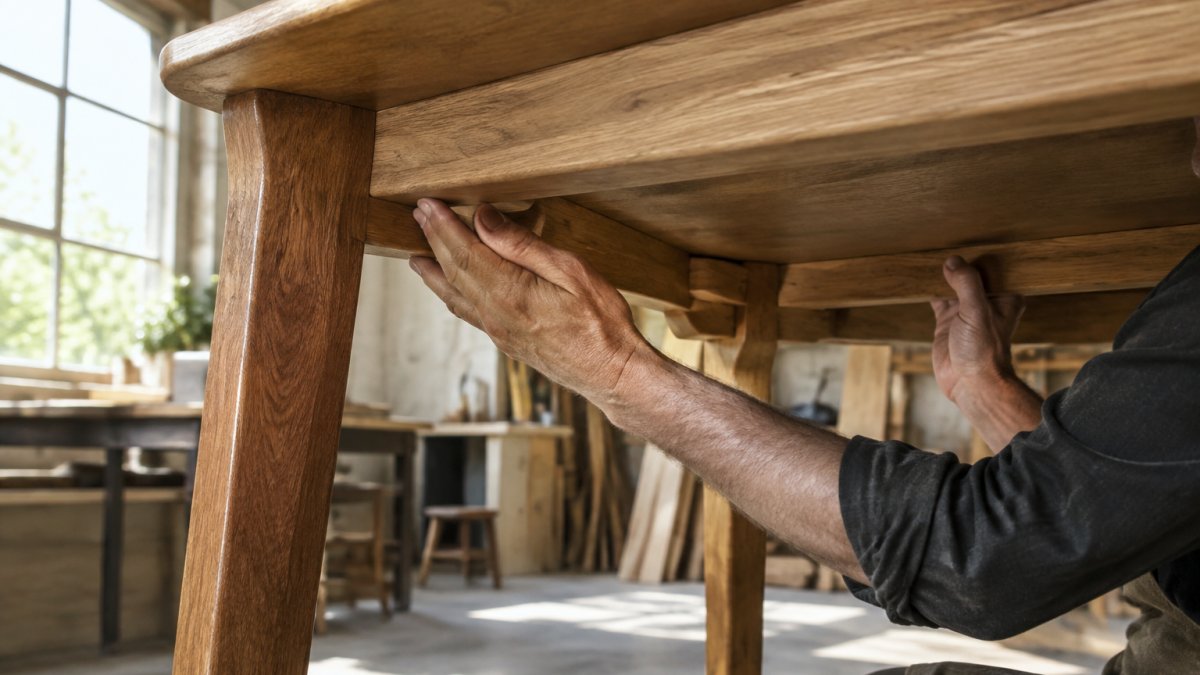
Here's the full sequence at a glance:
| Step | What You Check | Time | Red Flag |
|---|---|---|---|
| 1. Stability | Wobble, racking, weight | 2 min | Any side-to-side rock |
| 2. Joinery | Joint tightness, fasteners | 3 min | Gaps or visible screws in load points |
| 3. Finish | Surface feel, grain, edges | 2 min | Rough patches, drips, uneven sheen |
| 4. Moisture | Wood movement, drying | 1 min | Warped panels, tight drawers |
| 5. Upholstery | Seams, weave, alignment | 2 min | Loose threads, mismatched patterns |
Step 1: Test Strength and Stability
Push gently on one corner of the piece. A well-built table or chair should resist racking, meaning it shouldn't twist or rock side to side. Sit on it if it's seating. Lean on it if it's a table. A common mistake is testing on carpet, which hides wobble; test on a hard floor instead.
Step 2: Examine Joints and Construction
Turn the piece over and look at the joints. Dovetail joints and mortise-and-tenon joints signal real workmanship. Glue joints should be tight with no gaps. Watch out for screws driven straight into end grain at load points, which is a weak fix that fails over time.
Step 3: Inspect Finishes and Surface Details
Run your hand across the surface. A quality finish feels smooth and even, with no drips, rough patches, or sticky spots. Check the edges and the underside too, since makers who cut corners skip the parts you don't see. Even sheen and consistent grain direction are good signs.
Solid Wood vs. Veneer Furniture: How to Tell the Difference
The quickest test is to look at the edges and the grain. Solid wood shows continuous grain that wraps around corners and end grain at the edges. Veneer and engineered wood like MDF or plywood show a thin top layer with a different core underneath.
Check these spots:
- Edges: Solid wood has visible end grain; veneer shows a seam or a uniform band.
- Grain: Real grain repeats naturally; veneer patterns can look mirrored or identical across panels.
- Weight: Hardwood feels heavier than a hollow MDF build of the same size.
- Sound: Tap the surface. Solid wood sounds dull and dense; a hollow core sounds thin.
You can see how a solid build looks in our recycled solid teakwood dining table, which features a panel-leg design and a natural wood grain finish.

Questions to Ask a Furniture Maker Before You Buy
Ask directly, and listen for specifics. A maker who builds by hand can tell you the wood species, the joinery method, the finish, and the drying process without hesitation. Vague answers are a warning sign.
Bring these questions:
- What wood species and joinery do you use?
- How is the wood dried, and to what moisture level?
- What finish do you apply, and how do I care for it?
- Is this made to order, and what's the lead time?
- What does the warranty cover, and can the piece be repaired?
Before committing to a higher price, it helps to read a realistic take on whether high-end furniture is worth it.
Signs of Poor Furniture Construction to Watch For
Poor construction leaves clues. Learn them and you'll spot a knockoff fast. Watch out for these:
- Wobble that won't sit flat on a hard floor
- Loose joints or gaps where parts meet
- Cracks, splits, or warping in panels
- Drawer slides that stick or feel flimsy
- Staples or visible screws where joinery should be
- Uneven finish or overspray on hardware
Any one of these isn't automatically fatal, but several together mean the piece won't hold up. Understanding what quality costs helps here; our guide on why artisan home decor costs more explains where the money actually goes.
How to Verify a Piece Is Genuinely Handmade
"Handmade" has no legal definition in furniture marketing, so the word on a tag proves nothing on its own. Verification means matching claims to physical evidence and documentation. Authenticity leaves a paper trail and physical marks, and the strongest cases combine both.
Start with documentation. Ask the maker for process photos or video of the piece or its siblings being built, the workshop location, the names of the people who build, and the wood supplier. A maker who builds by hand can usually produce these without much delay. Watch out: stock photos of a generic workshop, or process images that don't match the piece's species, joinery, or finish, are a warning sign rather than proof.
Uma Recycled Solid Teakwood Dining Table – Timeless Elegance & Durability →
Look for maker marks and labels. Handmade furniture often carries a maker's mark, stamp, brand, or signed label, sometimes with a serial number or build date. Check the underside, the back, and the inside of drawers. A mark that names the maker and can be traced to a workshop is stronger evidence than an unattributed sticker.
Read the physical evidence of handwork. Machine production tends to be uniform; handwork leaves small variations. Look for:
- Tool marks in hidden areas, such as plane or chisel marks on the underside of a top or inside a drawer side.
- Joinery layout marks, such as pencil or knife lines near dovetails or mortises.
- Slight asymmetry in hand-cut dovetails, where the pins and tails vary a little rather than being identical across every drawer.
- Finish variation that follows the grain rather than a perfectly uniform factory coat.
- Species consistency between the visible surfaces and the parts you can see underneath.
These signs are evidence, not proof on their own. A single hand-cut dovetail on an otherwise machine-built case is a marketing detail, not a handmade piece.
Ask questions that separate makers from resellers. A maker can describe the joinery method, the wood's drying process, the finish schedule, and the lead time without hesitation. A reseller often cannot. Ask who built the piece, where, and with what joinery, and ask for the name of the workshop. Vague answers are a warning sign.
Check the warranty and repairability story. A maker who stands behind handwork usually offers a written warranty that names the maker or workshop, care instructions for the specific finish, and a path for repair or replacement parts. A warranty that covers only shipping damage, or that has no repair option, suggests the seller is not positioned to support the piece long term.
Compare price and lead time to the construction story. Genuine made-to-order handwork usually carries a lead time measured in weeks and a price that reflects labor. A piece marketed as handmade but stocked in quantity, shipped in days, and priced like mass-market furniture deserves a closer look at the joints and documentation before you accept the claim.
Handmade pieces can show small variations in color and texture, which are part of their handcrafted character. For a deeper walkthrough, see our guide on how to verify artisan decor authenticity.
Wood Moisture, Movement, and Drying: What to Check
Wood moves as humidity changes, so drying matters (Drying and control of moisture content and dimensional changes). Properly dried wood is stable; poorly dried wood warps, cracks, and splits after it's in your home. Ask the maker how the wood was dried and to what moisture content.
In practice, check for:
- Warped panels or a top that isn't flat
- Drawers that stick in humid weather
- Gaps that open and close with the seasons
- Cracks near joints or panel edges
Academic work on furniture design has explored joints built to last through repeated use and changing needs, as described in an MIT thesis on long-lasting furniture joints. Good joinery accounts for movement instead of fighting it.
Evaluating Upholstery Seams and Fabric Quality
Turn the cushion over and inspect the seams. Even, tight stitching with no loose threads signals care. Pattern alignment across seams is another tell: quality upholstery matches patterns at the joins, while cheap work lets them drift.
Look for:
- Seams that lie flat with no puckering
- Fabric weave that feels dense, not thin
- Pattern alignment matched at the seams
- Loose threads or skipped stitches
A tight weave and clean seams mean the piece will hold its shape. Loose stitching fails first at the stress points, usually within a year or two of daily use.
Start Your Inspection With Confidence
The best pieces reward a close look, and now you know exactly where to look. Our curated collection is built around artisan traditions and quality craftsmanship, with many furniture pieces made to order. Browse the collection to see solid construction up close, and subscribe to our emails for first looks at new arrivals and sourcing stories. Subscribe to our emails for first looks at new arrivals and sourcing stories.
Frequently Asked Questions
How can you tell if handmade furniture is high quality?
Start by checking the joinery: look for dovetail or mortise-and-tenon joints rather than screws alone. Run your hand along surfaces for smoothness, and inspect the grain to confirm solid wood rather than veneer. Test stability by pressing down on corners to feel for wobble. Ask for documentation and a maker's mark. Online shoppers often rely on customer reviews to judge long-term durability, so combine in-person inspection with verified buyer feedback.
What should you inspect when buying handmade furniture?
Use a handmade furniture inspection checklist: check joints for tightness, examine the finish for cracks or uneven application, test drawers and doors for smooth operation, and look for alignment of seams and pattern matching. Verify solid wood versus veneer by examining end grain and edges. Ask about wood moisture content and drying methods. Also review the warranty and repairability. Bring a flashlight to spot surface defects and a small level to check for warping.
How can you tell whether furniture is solid wood or veneer?
Look at the end grain on legs and edges: solid wood shows continuous grain patterns that wrap around corners, while veneer has a thin top layer with a different substrate underneath. Check the underside of tabletops for repeating grain patterns, a sign of veneer. Solid wood feels heavier and cooler to the touch. Also examine joints: solid wood pieces often use mortise-and-tenon or dovetail joinery, while veneered furniture may rely on screws and staples.
What questions should you ask a furniture maker before ordering?
Ask about the wood species and where it was sourced, the joinery methods used, and the finish applied. Request details on moisture content and drying process. Ask whether the piece is made to order and what the lead time is. Inquire about the warranty, return policy, and repairability. Finally, ask for customer photos or references and whether the maker signs or labels their work. These questions reveal both craftsmanship and transparency.
