

7 Luxury Sculptural Ceramics for Your Home Interior
Quick Summary
Luxury sculptural ceramics are handmade objects chosen for their form, glaze and texture rather than for filling a surface. The best pieces become a room's anchor because their silhouette reads from across the room and shifts with the light. Choose them by checking listed dimensions, weight, base stability and the light where they will sit.
- Sculptural ceramics earn their place through shape, glaze and texture rather than filling space.
- Handmade pieces cost more because they take time at the wheel, in the kiln and at the glaze bench.
- Trust the listed dimensions over the styling shot when judging a piece's size.
- Build a grouping around one anchor piece and use odd numbers of objects.
- Leave at least a hand's width of empty surface around a grouping to avoid crowding.
Table of Contents
- Why Sculptural Ceramics Work Better Than Decorative Filler
- Luxury Handmade Ceramics: What Actually Justifies the Price
- 7 Sculptural Ceramic Vases and Objects for Home Interiors
- Buying Criteria: Dimensions, Weight, Stability, and Placement
- How to Style Ceramic Sculpture Home Decor With Existing Interiors
- Materials, Construction, and Caring for Your Pieces
- Building a Luxury Ceramic Home Decor Collection You Will Keep
- Frequently Asked Questions
Why Sculptural Ceramics Work Better Than Decorative Filler
Last Updated: November 7, 2026
Sculptural ceramics are objects that earn their place on a shelf or console through form alone. At Che Bella Casa, we select pieces where the shape, glaze and texture do the work, rather than filling a surface with something that simply takes up room. The global pottery ceramics market was estimated at $11.83 billion in 2024 and is projected to reach $17.27 billion by 2033 (Kiln Frog, Pottery Statistics & Data to Know in 2026), which shows how much demand exists for well-made ceramic objects.
Decorative filler is easy to buy and easy to forget. A sculptural piece is different. It has a silhouette you can read from across the room, and it changes with the light through the day. That is the core difference, and it is why the best pieces tend to become the room's anchor rather than background noise.
There is a practical reason to choose carefully as well. Ceramics intended to look decorative can still fall under food-safety rules if they might ever hold food, so it is worth asking how a piece is made. The U.S. Food and Drug Administration guidance on decorative ceramicware addresses how ornamental and decorative ceramicware must be made and sold to comply with 21 CFR 109.16.
Luxury Handmade Ceramics: What Actually Justifies the Price
Handmade ceramics cost more because each piece takes time at the wheel, in the kiln and at the glaze bench.
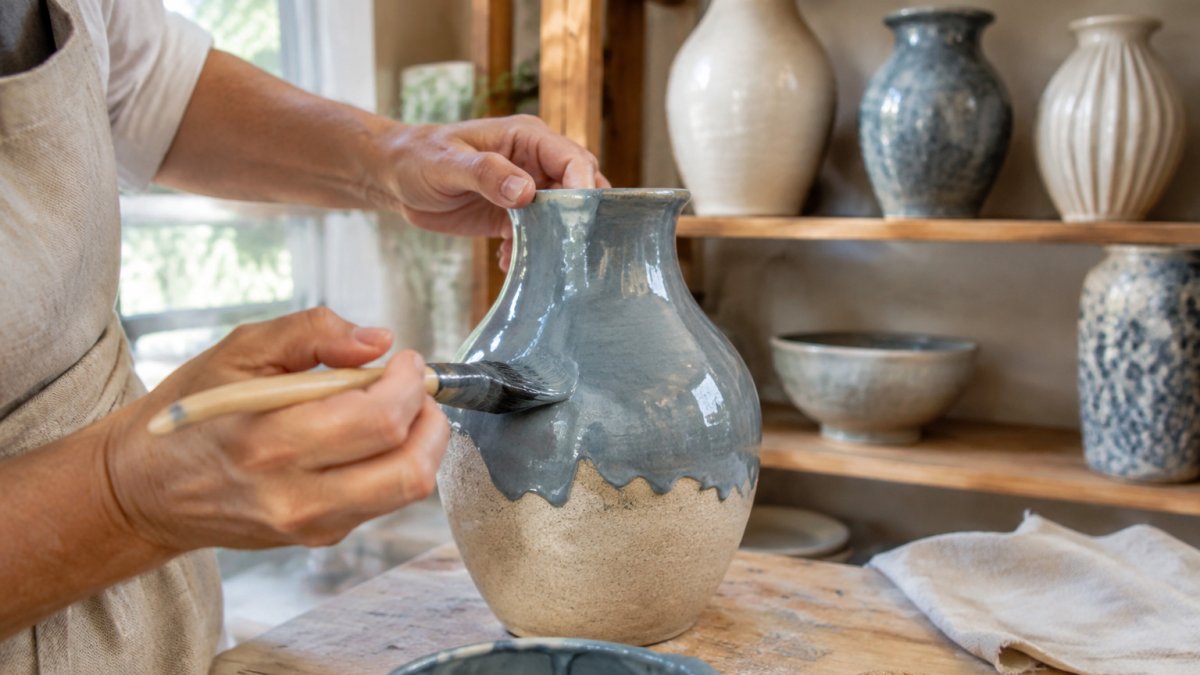
The market data supports the premium segment as well. The luxury ceramic ware market was valued at $8,811.33 million in 2026 and is expected to reach $16,910.14 million by 2035 (Market Growth Reports, Luxury Ceramic Ware Market Trends). That estimate covers the category broadly, so treat it as a sign of demand rather than a guide to any single piece.
When you compare prices, look at what you are actually paying for: the making, the glaze, the finish and the individual character of the piece. A lower price often means a more uniform, mass-produced object.
7 Sculptural Ceramic Vases and Objects for Home Interiors
These are the sculptural ceramics from our current catalogue. Each one is listed at its current price.
1. Lupe Vase ($117.98). Its artfully sculpted silhouette reads as classical reimagined through a modern lens. The soft matte finish and muted glaze suit both minimalist and eclectic rooms. Shop the Lupe Vase.

2. Stoneware Vase with Twisted Handles ($48.99). Handcrafted stoneware with a reactive glaze means no two vases match. The twisted handles add visual interest, and the piece is watertight for fresh flowers.
3. Green Ceramic Leaf Vase ($21.99). Sculpted leaves with embossed veining form a bulbous shape. It comes in two sizes, and it is the most accessible option here if you want a sculptural accent without a large spend.
4. Decorative Handmade Paper Mache Vase ($201.82). Its textured, lightweight surface makes it an art object in its own right. It suits compact spaces and larger rooms alike.

5. Green & Cream Chinoiserie Vases ($62.99). This set of three crackled ginger jars has varying heights, so it works as a grouping on a console or mantel.
6. Navy Textured Ginger Jars ($36.99). The deep navy finish contrasts strongly with white blooms and works in traditional and modern rooms alike. The three sizes let you layer a display.
7. Ruyi and Peony Chinoiserie Porcelain Jar ($95.00). Blue-and-white porcelain with a peony motif and a sculpted ruyi-style lid anchors a console or bookshelf with a classic feel.
Best for: anyone building a single focal point or a small grouping. Skip if: you need a functional planter for large, heavy arrangements.
Buying Criteria: Dimensions, Weight, Stability, and Placement
Most product pages give you a height and a width and nothing else. That is not enough to choose a piece that will actually look right on your shelf. Use this four-part framework before you buy.
Dimensions and the fill ratio. Measure the height, width and depth of the surface, then compare the piece's footprint to that surface, and check the listed dimensions before you buy. Also check the height against what sits above, so the silhouette is not clipped.
Weight and placement. Check the listed weight of each piece and place lighter objects on stable surfaces away from heavy traffic.
Stability. Check that the base is flat and sits flush before placing a piece on a surface.
Placement and light. Glaze reads differently under different light, so view the piece in the light where it will live. Keep sculptural ceramics out of high-traffic walkways.
Watch out: always trust the listed dimensions over the styling shot.
Use these four checks, in order, before you buy a piece.
| Check | What to look at | Note |
|---|---|---|
| Dimensions and fill ratio | Height, width and depth against the surface | Trust the listed dimensions over the styling shot |
| Weight and placement | Listed weight of each piece | Keep lighter objects on stable surfaces |
| Stability | Base flat and flush on the surface | Check before placing the piece |
| Placement and light | Where the piece will live | Glaze reads differently under different light |
How to Style Ceramic Sculpture Home Decor With Existing Interiors
Styling is where most sculptural ceramics either earn their price or disappear into clutter. The difference is rarely the piece, it is the grouping, the scale relationship and the negative space around it. Here is a repeatable method.
Start with one anchor and build in odd numbers. Choose the largest piece first and treat it as the focal point, then group smaller pieces around it.
Control scale against the furniture. A sculptural vase should relate to the piece it sits on, not float above it.
Match color by pulling, not matching. Do not buy a navy jar to match a navy sofa exactly. Instead, pull a secondary color already present in the room, a shade from a rug, a throw, a piece of art, and let the ceramic echo it at a different value. A deep navy ginger jar against a cream wall and a camel throw works because the navy repeats the room's darkest tone without competing with it. A green leaf vase next to a live plant works for the same reason: it repeats a hue already in the space.
Mix finish and texture deliberately. Pair a glossy glazed piece with matte linen, raw wood or plaster. Two high-gloss objects side by side fight each other; one gloss against one matte lets each read. This is also where handmade variation helps, a reactive glaze with pooling and tonal shifts adds the texture a mass-produced piece cannot.
Protect negative space. Leave at least a hand's width of empty surface around a grouping. Crowding is the most common styling error, and it is what makes a $200 piece look like a $20 one. If a surface feels full, remove an object rather than adding one.
Room-by-room placement. Use a single tall anchor on an entry console so it reads from the doorway, and keep dining-table pieces low so sightlines stay open.
Watch out: styling around a television or a mirror multiplies the silhouette, which can make a bold piece read as twice its size; test the arrangement before committing.
Materials, Construction, and Caring for Your Pieces
Check each product's listing for its material and care notes.
Follow the care instructions on each product page. Some listings recommend wiping with a soft, damp cloth and hand washing.
Building a Luxury Ceramic Home Decor Collection You Will Keep
Build slowly. Buy one piece you love, live with it for a few weeks, then add the next. A collection built this way reflects your taste rather than a trend.
If you are furnishing a whole room, pair sculptural ceramics with other considered pieces. Our sustainable luxury furniture guide for 2026 covers how to plan a lasting room around pieces meant to last. Browse the full range of handmade ceramic vases and objects to find pieces that fit your space.
Frequently Asked Questions
What are sculptural ceramics?
Sculptural ceramics are clay objects made primarily to be looked at, where form, surface and proportion matter as much as function. They may hold flowers, but many are shaped as abstract vessels, faceted forms or figurative pieces that work as art. In a home they usually sit alone or in small groups on a console, shelf or mantel, and their value comes from how the silhouette and glaze read in the room.
How do you choose a sculptural ceramic vase for a home?
Start with the surface where it will sit and measure its height and width before you shop. The Lupe Vase at $117.98 and the Navy Textured Ginger Jars, which come in three sizes, show how a shape can be offered across different scales. Check the listed details for each piece, including whether it is watertight if you plan to display fresh flowers.
How do you style sculptural ceramics at home?
Group pieces in odd numbers and vary their heights so the eye moves across the arrangement. The Green & Cream Chinoiserie Vases are sold as a coordinating set of three sizes, which makes them easy to place on a console table as one vignette. Pair glossy glazes with matte or natural textures such as wood or linen, and leave some open space so each piece has room to be seen.
Are handmade ceramic pieces worth the price?
Whether a piece is worth its price depends on how you will use it: a $36.99 textured jar and a $201.82 handmade paper mache vase serve different budgets and different levels of investment. Judge the finish, the construction and the dimensions against what you need in your room.
