

7 Hand Woven Textiles That Transform a Living Room
Quick Summary
Hand woven textiles bring visible irregularity, tactile depth and a handmade quality that machine-made fabric rarely matches. A wool throw is the simplest entry point, since it layers easily over a sofa and can be moved or replaced without redecorating the room.
- Start with a wool throw over the sofa, since it is the lowest-risk way to add a hand woven textile.
- Size a sofa throw to cover roughly one-third to one-half of the sofa length, with 50 by 60 inches a common living-room size.
- Layer the room in order: rug first, then seating, then one wall hanging, then cushions and curtains.
- Choose wool for upholstery where possible, because its natural crimp and elasticity resist crushing and spring back after sitting.
- Hang a wall hanging so its center sits at eye level, about 57 to 60 inches from the floor.
Table of Contents
- Why Hand Woven Textiles Work So Well in a Living Room
- 1. A Wool Throw to Layer Over the Sofa
- 2. Woven Wall Hangings for Visual Interest
- 3. Handwoven Upholstery Fabric on Accent Chairs
- 4. How to Mix Textures in a Living Room Without Clutter
- 5. Choosing Colors and Sizes That Fit Your Space
- 6. Caring for Hand Woven Pieces So They Last
- Pick Your First Piece and Build From There
- Frequently Asked Questions
Why Hand Woven Textiles Work So Well in a Living Room
Hand woven textiles bring a quality that machine-made fabric rarely matches: visible irregularity, tactile depth and a sense that someone made the piece by hand. That imperfection is exactly what makes a living room feel lived in.
Hand woven textiles are fabrics built thread by thread on a loom, typically with natural fibers such as wool, linen or cotton. Their irregular weave catches light differently from flat, mass-produced cloth, which gives a room depth without adding clutter. They also layer well.
A handwoven throw that softens over years fits the idea of pieces that improve with age rather than follow fast trends. The seven pieces below show how to use hand woven textiles in a living room, from a sofa throw to a wall hanging to accent seating.
1. A Wool Throw to Layer Over the Sofa
A wool throw is the simplest way to bring a hand woven textile into a living room, and it works in almost any color scheme. Drape it over one arm of the sofa or fold it across the seat cushions to break up a large upholstered surface.
Our Teal Blue Indian Wool Throw Blanket, TOPAS, is a good starting point. It is hand-loomed, hand-spun and hand-dyed by skilled artisans in the Kutch region of India, and it works as a couch throw, a sofa cover or a decorative blanket. It is priced at $220.00.
Choose a throw whose color picks up one accent already in the room, such as a cushion or a lamp base. That repetition makes the textile look chosen rather than added.
2. Woven Wall Hangings for Visual Interest
A woven wall hanging adds height and pattern to a wall that would otherwise be bare. Hang it above the sofa or a console table, and keep its width to roughly two-thirds of the furniture below it.
Hand-woven textile art works well when the rest of the room is restrained. If your sofa and rug are plain, a textured wall piece gives the eye somewhere to rest. If the room already has strong pattern, choose a wall hanging in a single color.
For a wall piece with a bold, contemporary character, consider the Vibrant Feathers Western Wall Art, a framed canvas print with bold colors and a panoramic format that suits a wide living room wall.
3. Handwoven Upholstery Fabric on Accent Chairs
Upholstered accent chairs let you introduce hand woven fabric at seating height, where it is touched every day. The mistake most buyers make is choosing upholstery by look alone.
A practical way to compare fibers for upholstery is to look at how each one wears, cleans, and ages:
- Wool. The most forgiving upholstery fiber for handwoven construction. Wool fibers have natural crimp and elasticity, so a tight wool weave resists crushing and springs back after sitting. It takes dye deeply, which is why hand-dyed wool holds color longer than many plant fibers. Trade-off: wool can pill on high-friction arms and needs low-moisture cleaning.
- Linen. Stronger than cotton when dry and gets softer with use, but it wrinkles and can abrade at sharp edges. Best on chairs with rounded arms and low traffic.
- Cotton. Affordable and easy to clean, but a loose cotton weave compresses and can sag on seat cushions over time. Look for a tight, even weave and a backing.
- Recycled and blended fibers. Increasingly common in handwoven upholstery. Blends trade some of wool's resilience for stain resistance and lower cost; check the blend ratio, because a high synthetic share can reduce the breathability that makes handwoven fabric comfortable.
Weave matters as much as fiber. A tight plain weave or a dense twill holds up better on a seat than an open basket weave, which is beautiful on a wall hanging but can snag on buttons and zippers.
Ask for a rub-count (Martindale or Wyzenbeek) if you are buying yardage; higher counts suit family rooms, lower counts suit occasional chairs.
If you want a natural-fiber seat rather than upholstery, the Tenang Relax Lounge Chair, handwoven from water hyacinth, is an alternative.
Teal Blue Indian Wool Throw Blanket, Handwoven Couch Coverlet with Geometric →
4. How to Mix Textures in a Living Room Without Clutter
Mixing textures is what makes a hand woven room look deliberate. The rule we use is to pair one soft texture, such as wool or brushed fabric, with one structured texture, such as a tightly woven rug or a wood or rattan piece, and then keep the rest of the palette calm.
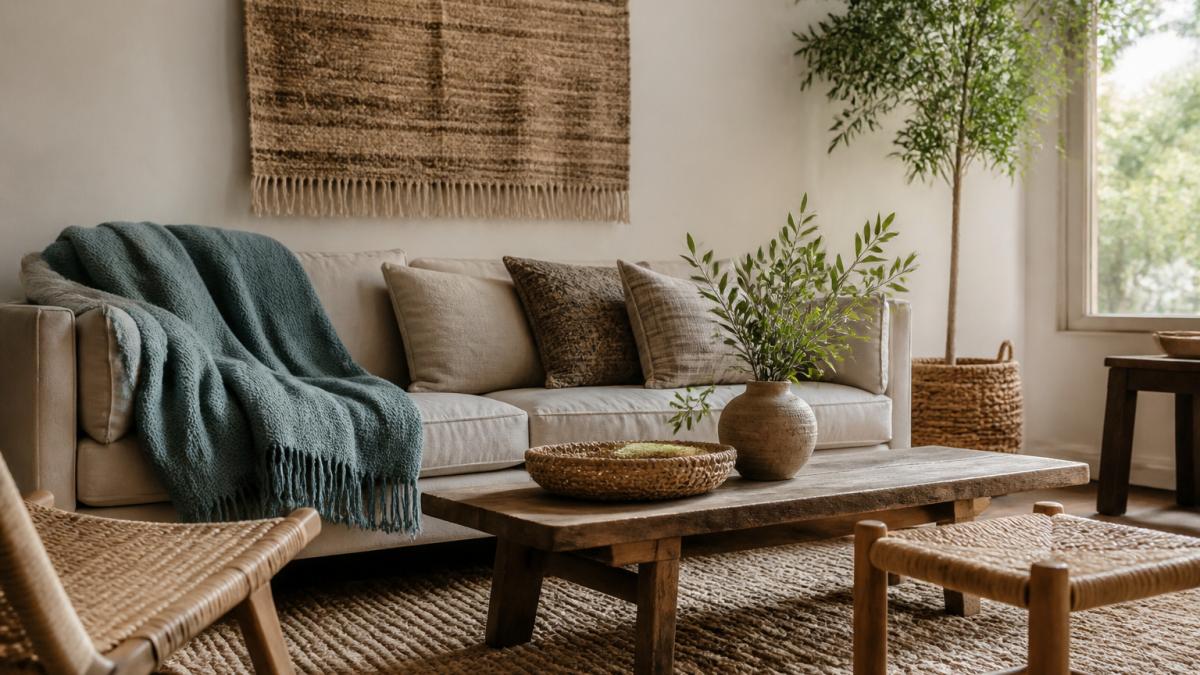
Start with a neutral base: a sofa in one color, a rug in another, and walls that stay quiet. Add the woven throw next, then one wall hanging, then one accent chair. Stop there before adding anything else. Most rooms look crowded because they have too many textures competing at the same scale.
Vary the scale of your textures. A chunky knit throw works well against a fine linen cushion, because the difference in weight keeps the room from looking uniform.
5. Choosing Colors and Sizes That Fit Your Space
Color and size decide whether a textile looks right in a room, and both are easier to judge before you buy than after. Most ranking guides stop at "pick a color you love." The more useful approach is to size each textile to the furniture it touches and to layer the room in a fixed order, so the pieces relate to each other instead of competing.
Size each piece to its anchor
- Sofa throw. Drape it so it covers roughly one-third to one-half of the sofa length. On a standard 84-inch sofa, that is about 28 to 42 inches of visible throw. A throw narrower than about 50 inches will look like a scarf; 50 by 60 inches is a common living-room size.
- Area rug. In a living room, the rug should sit under the front legs of every main seating piece, or extend at least 6 to 8 inches beyond the sofa on each side. A common mistake is a rug that floats in the middle of the seating group; measure the seating footprint first, then add 18 to 24 inches on the open sides.
- Cushions. On a standard sofa, two 20-inch or 22-inch cushions fill the back, or one 24-inch cushion per seat. Mix one larger and one smaller cushion per seat rather than matching sizes exactly.
- Curtains. Curtain panels should be about 1.5 to 2 times the window width so they hang with fullness, and should reach the floor or just break at it. Handwoven curtains are usually unlined, so check the weave density against the light before buying.
- Wall hanging. Keep the width to roughly two-thirds of the furniture below it, and hang the center at eye level, about 57 to 60 inches from the floor.
Layer in a fixed order
A room-by-room placement method keeps a handwoven living room from looking cluttered. Work in this sequence and stop when the room feels resolved:
- Floor first. Choose the rug, because it sets the color temperature for everything above it.
- Seating second. Add the sofa or chairs, then the throw that lives on them.
- Vertical third. Add one wall hanging or textile art piece to give the eye height.
- Soft layer last. Add cushions and curtains to tie the palette together.
Judge color in the room's real light
Hand woven colors shift under warm and cool light. A teal that looks calm at noon can look greener at night; a neutral ivory can read as warm beige under yellow lamp light. Take the textile to a window in the morning, then view it under the room's evening lamps before deciding. A practical guide to visualizing decor in your space covers methods for previewing color and size before you buy. Natural dyes can also vary slightly from piece to piece, which is a feature of handwork rather than a defect.
The table below lists the sizing and placement guidance from this section so you can check each piece before you buy.
| Piece | Size guidance | Placement note |
|---|---|---|
| Sofa throw | About 28 to 42 inches visible on an 84-inch sofa | 50 by 60 inches is a common living-room size |
| Area rug | Extend 6 to 8 inches beyond the sofa on each side | Measure the seating footprint first |
| Cushions | Two 20 or 22-inch cushions for the back | Mix one larger and one smaller per seat |
| Curtains | 1.5 to 2 times the window width | Reach the floor or just break at it |
| Wall hanging | Width about two-thirds of the furniture below | Center at 57 to 60 inches from the floor |
6. Caring for Hand Woven Pieces So They Last
Hand woven textiles last longer when you treat them as cared-for objects rather than disposable decor. Vacuum wool throws on a low setting with an upholstery attachment, and avoid leaving them in direct sunlight for long periods.
Spot-clean stains promptly with a cool-water solution and blot rather than rub.
Pick Your First Piece and Build From There
Start with one piece rather than redecorating the whole room at once. A wool throw is the lowest-risk choice, since it is easy to move, layer or replace. Once it is in place, you will see which texture or color the room needs next, whether that is a wall hanging, a rug or an accent chair.
Explore our full range of hand woven throws, including the Teal Blue Indian Wool Throw Blanket, TOPAS, at $220.00, and find the piece that suits your living room.
Frequently Asked Questions
How do you decorate a living room with hand woven textiles?
Start with one anchor piece, such as a wool throw over the sofa or a woven wall hanging, then add two or three supporting textiles in related colors. Choose items that share a palette but differ in texture, like a smooth linen cushion beside a chunky wool throw. Keep the number of pieces small so each one reads clearly. Che Bella Casa's wool throws, priced at $220.00, work well as this anchor because their handloomed texture and earthy tones pair with most neutral furniture.
What types of woven textiles work best in a living room?
Wool throws and cushion covers are the easiest entry points because they are used daily and can be swapped out seasonally. Woven wall hangings suit empty walls above sofas or consoles. Handwoven upholstery fabric works well on accent chairs and benches, where the texture is felt as well as seen. Choose natural fibers such as wool, cotton, and linen for warmth and a tactile finish that synthetic fabrics rarely match.
How do you mix woven textures without making a room feel busy?
Limit the palette to three or four colors and vary the texture rather than the pattern. A smooth woven cushion, a nubby wool throw, and a flat-weave rug can sit together comfortably. Repeat one color somewhere else in the room so the textiles feel intentional. If the room starts to feel crowded, remove one item before adding another, and give each textile enough surface area to be appreciated.
How do you care for hand woven home textiles so they last?
Shake out woven throws and vacuum them with a brush attachment on low suction to remove dust without pulling threads. Rotate pieces so that sun exposure is even, and keep them out of direct, prolonged sunlight, which can fade dyes. Check the care label before any cleaning, and spot clean stains promptly.
