

How to Create a European Countryside Estate Interior
Last Updated: November 4, 2026
Quick Summary
A European countryside estate interior pairs Old World architecture with layered, lived-in furnishings in natural materials, muted colors, and pieces that show their age. To get it right, choose your anchor piece first, hold the whole house to five or fewer colors, and repair antiques rather than replacing them.
- Leave a minimum of 36 inches for main walking paths and 18 inches between a coffee table and a sofa.
- Pull furniture 12 to 18 inches off the walls so large rooms avoid a dead center.
- Mix roughly 60 percent wood, stone, and plaster to 40 percent linen, wool, and velvet.
- For every antique, add one clean-lined modern piece, and stop at three wood tones per room.
- Spend first on flooring, wall finish, and the anchor architectural element, then save on textiles and ceramics.
Table of Contents
- What Makes a European Countryside Estate Interior Feel Authentic
- European Country Living Room Ideas That Balance Comfort and Grandeur
- Building a European Cottage Interior with Warmth and Patina
- French Country Decorating Ideas for Estate-Scale Rooms
- Modern European Country Interior Design: Mixing Old and New
- A Cohesive Palette and Materials Guide for Countryside Estates
- Sourcing Antiques and Artisan Pieces Responsibly
- Start Curating Your Estate-Inspired Home
- Frequently Asked Questions
What Makes a European Countryside Estate Interior Feel Authentic
A European countryside estate interior style is a way of decorating large rural homes that pairs Old World architecture with layered, lived-in furnishings. It favors natural materials, muted colors, and pieces that show their age. The look rests on rooms that feel collected over time rather than bought in a weekend.
The look works because of restraint, not abundance. Most people get it wrong by filling every surface.
Authentic estate rooms share a few traits:
- Architectural character first. Stone arches, rough stucco walls, and warm wood flooring do more than any furniture.
- A neutral base. Pale stone, plaster, and linen set the stage.
- Patina over polish. Weathered finishes and rustic antiques carry the story.
- Texture, not color, for interest. Wool, ceramic, copper, and raw wood layer together.
The National Trust guidance on caring for historic interiors makes a useful point that applies to any old house: repair and conserve before you replace. That single habit separates a genuine estate interior from a themed one.
European Country Living Room Ideas That Balance Comfort and Grandeur
The best European country living room ideas start with one anchor piece and build outward. Grandeur comes from scale and architecture. Comfort comes from softness, and you need both in equal measure.
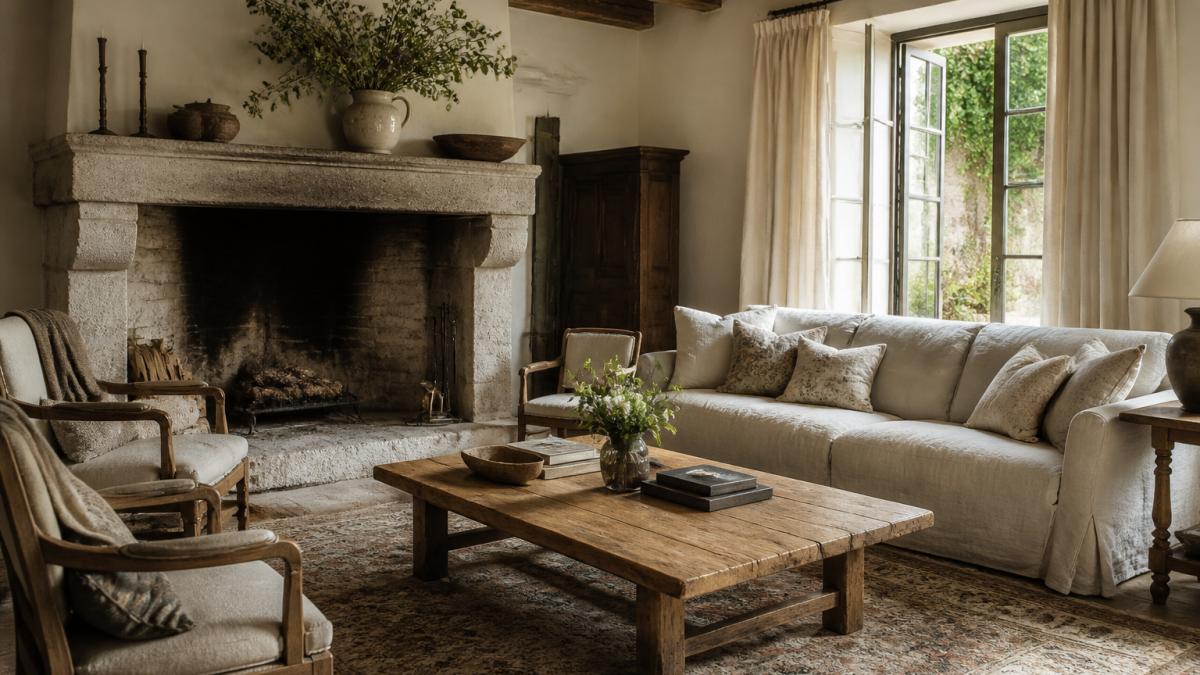
Start with proportion, not shopping. In rooms with high ceilings, a standard 84-inch sofa can read as a bench.
A workable order for estate-scale living rooms:
- Fix the anchor first. One fireplace, one armoire, or one statement window. Everything else is placed in relation to it, so choosing it last guarantees rework.
- Build conversation zones, not one ring. A 20-by-25-foot room usually wants two seating groups, a formal group around the fireplace and a secondary group near a window or bookcase, rather than one oversized U-shape that leaves a dead center.
- Float the seating. Pull furniture 12 to 18 inches off the walls. In large rooms, wall-hugging furniture creates a void in the middle that no rug can fix.
- Size the rug to the zone, not the room. A rug should sit under all four front legs of the seating group. In estate rooms, that often means a 9-by-12 or larger base rug with a smaller vintage rug layered at an angle for depth.
- Mix hard and soft at a 60/40 ratio. Roughly 60 percent wood, stone, and plaster to 40 percent linen, wool, and velvet keeps a grand room from feeling like a museum.
- Leave negative space on purpose. Empty floor between zones is what signals confidence; filling every square foot signals a showroom.
Lighting is the second half of comfort.
Watch out: buying the sofa before measuring the room is the single most common estate-scale mistake. A standard 84-inch sofa in a 20-foot room looks like doll furniture, and no amount of pillows corrects it.
If you want a deeper walkthrough of furnishing these rooms, our guide to European style furniture for home retreats covers the pieces that carry the look.
Building a European Cottage Interior with Warmth and Patina
A European cottage interior is smaller in scale but richer in texture. Where estate rooms rely on architecture, cottages rely on objects: painted antiques, worn wood, and handmade ceramics.
Patina is the whole point. A table with a water ring and a chair with rubbed arms reads as history. A factory-perfect replica reads as a showroom.
Watch out: stripping and refinishing every antique you buy removes the exact quality you paid for. Clean it, wax it, and leave the marks.
Ways to add warmth without clutter:
- Hang one plate wall instead of scattering plates everywhere
- Use painted antiques in soft gray, sage, or cream
- Add a large pitcher for branches or flowers
- Keep lighting low and layered with sconces and lamps
A vintage-inspired pitcher earns its place here. The Coppermill Kitchen Vintage Inspired Large Pitcher is sized for a dining table or buffet and works for drinks or flowers, which is exactly the kind of double-duty piece a cottage needs.

French Country Decorating Ideas for Estate-Scale Rooms
French country decorating ideas translate to big rooms through proportion, not decoration. The style is quieter than people expect: pale stone, soft textiles, and a few strong silhouettes.
Scale is where most large-room schemes fail. A standard sofa in a twenty-foot room looks like doll furniture. Measure the room, then buy the largest piece that still leaves walking room.
Key moves for estate-scale French country:
- Toile and linen in moderation. One upholstered piece, not five.
- Stone and plaster tones. Walls in chalky white or soft gray.
- Curves over angles. Rolled arms, turned legs, rounded tables.
- One rustic note per room. A rough beam, a stone trough, a weathered door.
Belgian influence sits close to this look, with more restraint and darker woods. Italian influence adds warmth and copper. Swedish influence brings in lighter woods and painted white. Mixing two of these is fine. Mixing all four is how rooms start to feel themed.
Modern European Country Interior Design: Mixing Old and New
Modern European country interior design works when the new pieces are deliberately quiet. Old and new should contrast, not compete.
The rule we use: for every antique, add one clean-lined modern piece. A rustic farmhouse table with modern leather chairs. A stone fireplace with a simple linen sofa. The tension is what makes the room feel current.
What most guides miss is that modern does not mean cold. Modern here means simple shapes and no ornament, not glass and chrome.
Tuscan-Inspired Hand-Hammered Copper Range Hood – Vintage Farmhouse Kitchen →
A short checklist for mixing:
- Choose a neutral modern piece with no visible hardware
- Keep modern lighting simple and sculptural
- Let antiques carry all the detail
- Repeat one material, such as wood or linen, across both eras
- Stop at three wood tones per room
For a step-by-step method, our guide on how to mix European rustic decor walks through the layering order.
A Cohesive Palette and Materials Guide for Countryside Estates
A countryside estate palette should hold to five or fewer colors across the whole house. Cohesion comes from repetition, not from matching sets.
Here is the framework we recommend:
| Layer | Colors and Materials | Where It Goes |
|---|---|---|
| Base | Pale stone, chalk white, warm plaster | Walls, ceilings, large rugs |
| Wood | Warm oak, walnut, weathered pine | Floors, tables, beams |
| Metal | Aged brass, copper, black iron | Lighting, hardware, accents |
| Textile | Linen, wool, cotton in oat and gray | Sofas, curtains, throws |
| Accent | Sage, terracotta, faded blue | Ceramics, art, small upholstery |
Carrying several of these layers into every room helps a house read as one estate rather than a set of separate projects.
Finish and sheen matter as much as color.
Apply the palette room by room rather than all at once:
- Entryway: base and wood dominate, one metal accent (a lantern or hardware), one textile (a runner). This is where you set the five-color rule for the rest of the house.
- Living room: all five layers, with accent concentrated in ceramics and art rather than upholstery.
- Kitchen: base, wood, and metal carry it; keep textiles to linens and a single runner so the room stays practical.
- Bedrooms: base and textile lead, wood secondary, accent limited to one throw or a pair of lamps.
Budget prioritization is where most projects go wrong. Spend first on the surfaces you cannot easily change later, flooring, wall finish, and the anchor architectural element, because they set the palette for everything else.
Materials matter more than color at this scale. Pale stone, fieldstone, rough stucco, and warm wood flooring are the bones. You can browse handcrafted European ceramic vases to put the palette guidance into practice.
Watch out: choosing a different accent color for each room is the fastest way to make an estate feel like a series of unrelated projects.
Sourcing Antiques and Artisan Pieces Responsibly
Sourcing responsibly means buying fewer pieces and knowing where each one came from. Ask every dealer the same questions before you pay.
What to ask:
- Where was this piece made, and when?
- What repairs has it had?
- Is the finish original or restored?
- Can you document the provenance?
- What is the return policy?
A common mistake is buying a container of antiques at once to fill a house. You end up with quantity and no cohesion. Buy slowly, one anchor piece per room.
For reproductions, look for makers who name their workshop and their method. Our guide on how to verify artisan decor authenticity helps you confirm what you are buying. Hand-thrown ceramics and hand-hammered metal show small irregularities. That is the signature of artisan work, not a defect.
The questions above are a useful starting point when comparing pieces.
Start Curating Your Estate-Inspired Home
Building a European countryside estate interior is a long game, and that is the point. The rooms that look best in photographs ten years from now are the ones furnished slowly, with pieces that were repaired instead of replaced.
Start with one room. Choose your anchor, set your five-color palette, and buy one piece that will outlast the trend cycle.
At Che Bella Casa, our collection is built for exactly this kind of room. Many furniture pieces are made to order. Our selection is chosen for artisan traditions and quality craftsmanship, from hand-woven textiles to sculptural ceramics.
Get started with Che Bella Casa and furnish your first room around a piece you will still love in twenty years.
Frequently Asked Questions
What defines European countryside estate interior style?
European countryside estate style blends rustic character with refined elegance. It draws on regional influences from France, Belgium, Italy, and Sweden, using natural materials like pale stone, rough stucco, and warm wood flooring. Neutral, nature-inspired palettes and patinated finishes create a lived-in, timeless feel. The look layers antiques, vintage furnishings, and artisan pieces rather than matching sets, so rooms feel collected over generations. Architectural details such as stone arches and exposed beams anchor the aesthetic, while chandeliers and sconces add warmth without formality.
How do you mix antique and modern furniture in a European-inspired home?
Start with a neutral base of pale walls and warm wood floors, then anchor the room with one or two substantial antique or vintage pieces, like a farmhouse table or armoire. Introduce modern seating or lighting to keep the space from feeling like a museum. Repeat materials such as aged brass, linen, or weathered oak across old and new pieces to tie them together. Scale matters in estate rooms: a large antique piece can handle a clean-lined modern sofa nearby. The goal is contrast with cohesion, not a period-perfect replica.
What colors work best in a European countryside interior?
Nature-inspired neutrals dominate: chalky whites, warm creams, soft grays, sage greens, muted blues, and earthy terracottas. These hues reflect the landscape and let natural materials stand out. Use deeper tones like olive or aged burgundy sparingly as accents in textiles or painted antiques. Avoid stark brights, which fight the patina of weathered finishes. Layer shades within the same family to create depth, and let stone, wood, and copper bring in additional color naturally. The result should feel calm, warm, and inviting rather than flat.
How can I make a living room feel like a European country estate?
Begin with architectural character: expose or add beams, use stone or plaster finishes, and choose warm wood flooring. Arrange furniture to encourage conversation, with a mix of a linen sofa, antique chairs, and a weathered coffee table. Layer vintage rugs and add textural elements like wool throws and linen curtains. Incorporate a statement chandelier or wall sconces for warm light. Finish with collected decorative objects, such as a vintage copper pitcher or handmade ceramic platter, and personal touches like books and fresh greenery to make the room feel lived-in and inviting.
A countryside estate does not come together in a season. It comes together one considered purchase at a time, and the patience shows in every room.
