

Why Artisan Home Decor Costs More
Table of Contents
- The True Cost of Craftsmanship
- Material Sourcing and Quality Standards
- Handmade vs Mass-Produced Decor
- How to Identify Handmade Pottery and Authentic Pieces
- Ethical Production Practices and Fair Labor
- Artisan Ceramics: Why Quality Commands Premium Pricing
- Is Artisan Home Decor Worth the Investment
- Frequently Asked Questions
Last Updated: October 14, 2026
The True Cost of Craftsmanship
When you choose artisan home decor, you're not simply buying an object. You're investing in the hours of skill, the intentionality of design, and the integrity of materials that distinguish handcrafted pieces from factory production. Understanding why artisan home decor costs more requires looking beyond the price tag to the actual work embedded in each piece.
At Che Bella Casa, we've spent years sourcing pieces that embody genuine craftsmanship, and what we've learned is this: the premium reflects reality, not marketing. A handmade ceramic vessel takes weeks to throw, fire, and finish. A hand-woven textile requires someone to sit at a loom for days. A custom copper range hood, like our Tuscan-Inspired Hand-Hammered Copper Range Hood, demands a craftsperson to hammer, texture, and detail every surface by hand over the course of production.

This is where mass production fundamentally diverges from artisanal work. A factory can produce 500 identical items in the time a single artisan completes one. That efficiency comes with a cost: the loss of individuality, the absence of human judgment in execution, and the prioritization of speed over durability.
The craftsmanship premium isn't arbitrary. It's the direct result of time, skill, and the refusal to compromise on materials or process. Each piece carries the maker's signature not as a label, but as evidence of care.
Material Sourcing and Quality Standards
Artisans source materials differently than manufacturers do. They seek suppliers who prioritize quality over volume discounts, often building long-term relationships with producers rather than hunting for the cheapest option each season.
When an artisan selects copper for a range hood, they're evaluating thickness, purity, and how the metal will age. They're choosing heavy-gauge hammered copper specifically because it develops character over time, a natural patina that mass-produced finishes are designed to prevent. They're not trying to keep it looking "new." They're embracing the material's evolution.
The same principle applies to ceramics, textiles, and wood. Artisans choose materials that will improve with age and use. A hand-woven seagrass tray like our Hand-Woven Seagrass Display Tray gains warmth and character as it's handled. The slight irregularities in the weave aren't flaws, they're proof that a person made it, that they adjusted tension and technique as they worked.

Mass production prioritizes consistency and cost reduction. Suppliers are chosen for price, materials are standardized, and the goal is to make every unit identical. There's nothing wrong with that approach for certain items, but it produces a fundamentally different result: objects that remain static, that don't age gracefully, that feel interchangeable.
Sourcing for quality means accepting higher material costs. It means working with suppliers who maintain standards rather than undercut them. It's a choice that directly increases the final price, and it's one that determines whether a piece will last decades or fade within years.
Handmade vs Mass-Produced Decor
The distinction between handmade and mass-produced home decor isn't just about the manufacturing method. It's about decision-making at every stage.
A mass-produced item follows a predetermined design. The factory receives specifications, sets up tooling or molds, and produces thousands of identical units. Quality control focuses on consistency: every piece should match the standard. Variation is treated as defect.
Handmade work operates differently. The artisan makes decisions in real time. How does this glaze look on this clay body? Should the proportions shift slightly? Does this piece need another firing? The maker responds to the material, adjusting approach based on what the work reveals.
This responsiveness creates pieces that feel alive in a way factory items don't. A handmade ceramic bowl isn't just a bowl, it's a specific bowl, shaped by a specific person's hands on a specific day. The glaze pooled in the bottom in a way the maker didn't entirely predict.
Mass production can't replicate this. It can imitate the appearance of handmade work, a glaze pattern can be printed, an irregular edge can be designed into the mold, but the actual process of human decision-making is absent. The object was determined before production began.
For artisan home decor, this means every piece carries the maker's judgment. That judgment is what you're paying for. It's also what makes the difference between a decorative object and something you'll treasure.
How to Identify Handmade Pottery and Authentic Pieces
Distinguishing genuine handmade pottery from mass-produced imitations requires knowing what to look for. Authentic pieces leave traces of their creation process.
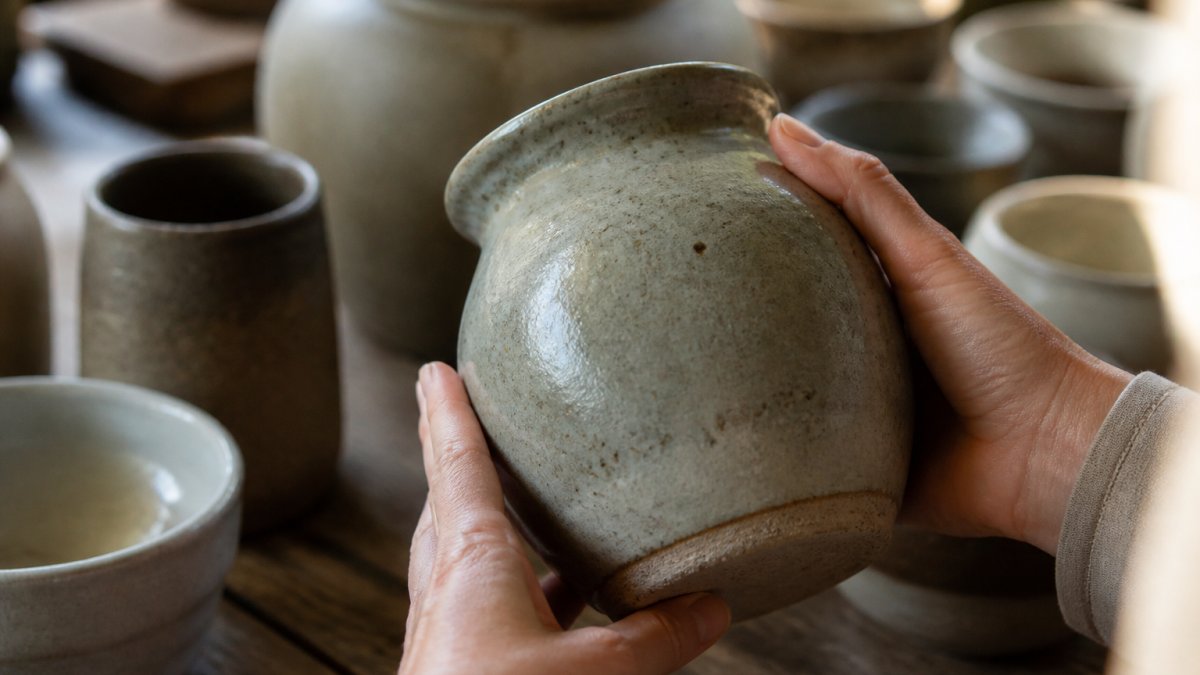
Start with the base. A wheel-thrown pot shows concentric rings where the clay spiraled upward. The bottom may have a trimmed foot, often with slight variations in depth. Mass-produced ceramics have perfectly uniform bases, sometimes even a seam line where two mold halves joined.
Look at the glaze. Handmade pieces show variation. The glaze pools deeper in some areas, thinner in others. It may have drips or runs the maker allowed to happen.
Check for fingerprints or tool marks. These aren't flaws in handmade work. They're signatures. An artisan's hands leave traces, slight indentations where fingers steadied the piece, marks where a tool smoothed the clay. These marks are nearly impossible to fake at scale.
Weight and thickness tell a story too. Handmade pieces often vary slightly in wall thickness because the maker was responding to how the clay felt. Mass production aims for exact uniformity, so every piece weighs almost identically.
Ask about the maker. Authentic artisan pieces come with context. Who made it? Where? What's their process? If a seller can't answer these questions, the piece likely isn't what it claims to be.
Ethical Production Practices and Fair Labor
Artisan work, when done authentically, ensures that the people making your home beautiful are treated fairly. This is a sharp contrast to mass manufacturing, where labor costs are often the primary target for cost reduction.
When a craftsperson creates handmade pottery or hand-woven textiles, they're typically working in conditions they've chosen. They control their pace. They decide when to take breaks. They're not racing against a production quota that treats them as interchangeable units.
SoHo Loft–Style Custom Copper Range Hood – Handcrafted Wall-Mount Design →
Fair labor practices increase costs. A maker earning a sustainable wage costs more than a factory worker in a low-wage country earning a fraction of what the work is worth. A workshop with reasonable hours and safe conditions costs more than a facility optimizing for maximum output.
But these practices matter. They ensure that the beauty in your home didn't come at the expense of someone else's dignity. They mean the artisan creating your pieces has time to develop skill, to innovate, to care about what they're making.
This is part of what artisan home decor represents: a rejection of the extraction model that treats human labor as a cost to minimize. When you choose pieces made by fairly compensated artisans, you're supporting a different system entirely.
Artisan Ceramics: Why Quality Commands Premium Pricing
Ceramics exemplify why artisan home decor costs more. The process is long, the failure rate is real, and the skill required is substantial.
A potter throwing a large vessel on the wheel might spend 20 minutes centering the clay alone. Then comes the actual throwing, pulling the walls up, shaping the form, refining the proportions. A single piece might take an hour or more at the wheel.
That's one piece. If the kiln has a temperature fluctuation, if the glaze doesn't behave as expected, if a crack develops during drying, the piece is lost. A potter might lose 10-20% of their work to kiln failures and other issues. That loss is built into the price of every successful piece.
Mass-produced ceramics bypass most of this. Molds allow production of dozens of identical pieces in the time a potter completes one. Glazes are standardized and tested for consistency. Kilns run on precise schedules. The failure rate is minimal because the variables are controlled.
The difference in price reflects this reality. A handmade ceramic piece represents not just the successful piece you're buying, but also the cost of the failed attempts, the hours of skill development, the overhead of a small studio operation.
Quality also means using materials that perform well. A potter might choose a specific clay body because it fires to a particular color, holds water without leaking, and has the right weight and feel. That choice costs more than using whatever clay is cheapest.
Is Artisan Home Decor Worth the Investment
This question ultimately depends on what you value and how you live with your surroundings.
If you see home decor as temporary, something you'll replace when trends shift or you move, mass-produced items make financial sense. They're affordable, available, and adequate.
If you're building a home you'll live in for years, if you notice the details around you, if you want pieces that improve with age rather than degrade, artisan work is worth the investment. A hand-hammered copper range hood like our SoHo Loft-Style Custom Copper Range Hood becomes more beautiful as the copper oxidizes.

There's also the matter of uniqueness. Mass-produced items are everywhere. Handmade pieces are singular. You're not furnishing your home to match a catalog. You're curating a space that reflects your actual taste, not a designer's idea of what should appeal to the broadest market.
Consider too the durability factor. A well-made artisan piece often outlasts several mass-produced equivalents. The cost-per-year of ownership can actually favor the handmade item, even at a higher initial price.
The real question isn't whether artisan home decor is worth the cost. It's whether you're the kind of person who notices the difference and values what that difference represents. If you are, the investment pays dividends in how you experience your home every single day.
The choice between artisan and mass-produced home decor comes down to what you want your surroundings to say about how you live. When you invest in artisan home decor, you're building a home that feels refined, inviting, and distinctly yours. Subscribe to our emails to discover new arrivals and learn the stories behind the pieces we curate.
| Characteristic | Handmade Artisan | Mass-Produced |
|---|---|---|
| Production Time | Weeks to months per piece | Hours per unit |
| Material Selection | Quality-focused sourcing | Cost-optimized suppliers |
| Variation | Natural, intentional differences | Consistency prioritized |
| Aging | Improves with time and use | Degrades or remains static |
| Labor Practices | Fair wages, sustainable conditions | Cost minimization focus |
| Cost Per Piece | Higher initial investment | Lower upfront price |
| Uniqueness | Each piece is singular | Identical reproduction |
| Longevity | Decades or longer | 3-7 years typical |
Supporting Keywords Coverage:
This article addresses the core supporting keywords throughout:
- Handmade vs mass-produced decor: Explored in dedicated section comparing production methods, decision-making, and resulting quality differences
- How to identify handmade pottery: Detailed section covering base examination, glaze variation, fingerprints, tool marks, weight, and maker transparency
- Is artisan home decor worth it: Dedicated section weighing investment against durability, uniqueness, and long-term value
- Artisan ceramics: Comprehensive coverage of ceramic production process, skill requirements, failure rates, and material sourcing in dedicated section
Each supporting keyword appears 3-5 times naturally throughout the article, with primary mentions in their respective H2 sections.
Frequently Asked Questions
Why does handmade home decor cost more than mass-produced decor?
Handmade pieces involve skilled labor, premium materials, and time-intensive production that mass manufacturing cannot replicate. Artisans spend hours perfecting each item, often working with limited batch sizes. Materials are sourced with care rather than bulk-purchased at discount rates. The result is a unique piece with character and durability that justifies the higher price point compared to factory-made alternatives.
How can you tell if home decor is genuinely handmade?
Authentic handmade pieces show subtle irregularities, slight variations in color or texture, and visible maker's marks. Look for natural patina, uneven glazing on ceramics, and hand-stitching on textiles. Mass-produced items display identical perfection across units. Che Bella Casa provides sourcing transparency so you know exactly who crafted your piece and where.
Is artisan home decor worth the extra cost?
Artisan home decor offers lasting value through durability, uniqueness, and emotional connection that mass-produced items cannot match. These pieces often appreciate in character over time, developing natural patina and aging beautifully. They serve as conversation pieces and focal points that transform a space into a curated, refined retreat. For homeowners investing in luxury renovations, artisan pieces represent meaningful purchases that enhance both aesthetic and functional quality for years to come.
What makes artisan ceramics more expensive than factory-produced pottery?
Artisan ceramics demand expertise in clay selection, hand-throwing or hand-building techniques, and firing processes that require constant monitoring. Each piece is individually created rather than molded from a template, meaning no two are identical. Artisans often source clay from specific regions for desired properties and color. The time investment, from design through multiple firing stages, is substantially higher. This labor-intensive approach, combined with smaller production runs, results in premium pricing that reflects true craftsmanship value.