

Which Luxury Home Decor Brands Nail Refined Mediterranean Style?
Last Updated: October 29, 2026
Quick Summary
The top luxury home decor brands for a refined Mediterranean style are those whose pieces still look intentional years after purchase, favoring hand-painted ceramics, aged wood and woven lighting over mass-market lookalikes. Check craftsmanship signals like visible brush variation, weight in the hand and a named origin before you spend.
- Look for visible brush variation, since decals repeat perfectly and perfect repetition is the tell.
- Keep the base three materials within two shades of each other and let one accent piece jump in saturation.
- Spend on the pieces you touch, like tabletop and lighting, and save on pieces you only see.
- The LIMONI POSITANO Dinner Plate is handcrafted and hand-painted in Deruta, Italy, at $98.00.
- Repeat materials instead of matching product lines, with stone, wood and woven fiber the safest trio.
Table of Contents
- What Separates Luxury Home Decor Brands From Mass-Market Lookalikes
- How Modern Mediterranean Interior Design Stays Refined
- The Mediterranean Color Palette That Reads Expensive, Not Costal Kitsch
- Mediterranean Decor Ideas by Room and Budget
- Indoor-Outdoor Living: Materials That Survive Sun, Salt Air and Real Life
- How to Identify Authentic Artisan Craftsmanship
- Mixing High-End Home Decor Brands Into One Cohesive Room
- Build Your Mediterranean Retreat With Che Bella Casa
- Frequently Asked Questions
What Separates Luxury Home Decor Brands From Mass-Market Lookalikes
The top luxury home decor brands for achieving a refined Mediterranean aesthetic are the ones whose pieces still look intentional years after purchase. That is the whole test. Mediterranean style rewards objects with weight, texture and history, and punishes anything that only photographs well.
Mass-market lookalikes copy the silhouette and skip the substance. A printed lemon motif is not the same as hand-painted stoneware. A resin urn is not terracotta. The difference shows up in the hand and in the glaze.
Below, we break down the signals worth checking before you spend, and where most buyers get it wrong.
Craftsmanship Signals to Check Before You Buy
- Hand-painted versus decal. Look for visible brush variation. Decals repeat perfectly, and perfect repetition is the tell.
- Weight in the hand. Dense stoneware and earthenware feel heavier than their size suggests.
- Honest edges. Slightly uneven rims signal hand-forming, not a defect.
- Named origin. A maker who names the workshop, the region or the craft tradition is giving you something to verify.
Watch out: "Mediterranean-inspired" on a label is a marketing phrase, not an origin. Ask what the piece is made of and who made it before you assume either.
How Modern Mediterranean Interior Design Stays Refined
Modern Mediterranean interior design is the discipline of editing. The aesthetic works when a few materials carry a room, not twelve.
Where most rooms go wrong is volume. Layering texture is the goal; layering stuff is the failure mode. One sculptural ceramic, one aged wood surface, one woven light fixture, and the room reads calm and expensive. Add a fourth and fifth competing accent and it reads like a theme restaurant.
Natural light does more for this look than any purchase. Keep window treatments light, keep surfaces matte, and let the sun do the work. The palette should feel sun-washed rather than staged.
The Mediterranean Color Palette That Reads Expensive, Not Costal Kitsch
The Mediterranean color palette that reads expensive is built on warm neutrals and earthy tones, with one saturated accent used sparingly. Think chalk white, olive, aged terracotta, soft ochre and a deep sea green. That is the whole list.
The kitsch version happens when every color shows up at full strength at once. A turquoise wall, orange tile and lemon-print everything is a postcard, not a home. Refined rooms keep the base quiet and let one piece carry the color story.
The Palette by Brand Category
The practical question is which luxury brands actually produce pieces in these tones, and how they differ. Here is how the palette maps to brand categories, with the trade-offs that matter at purchase.
- Hand-painted ceramics (the accent layer). Hand-painted ceramics anchor a table with lemon, olive and ochre glazes. The trade-off to weigh is the piece's construction and shipping care, not price alone.
How to Test a Palette Before You Commit
Buying one physical sample in each material and viewing them together in your room's light at different times of day is a practical way to test a palette. Screens can distort terracotta and olive, so judge samples in person.
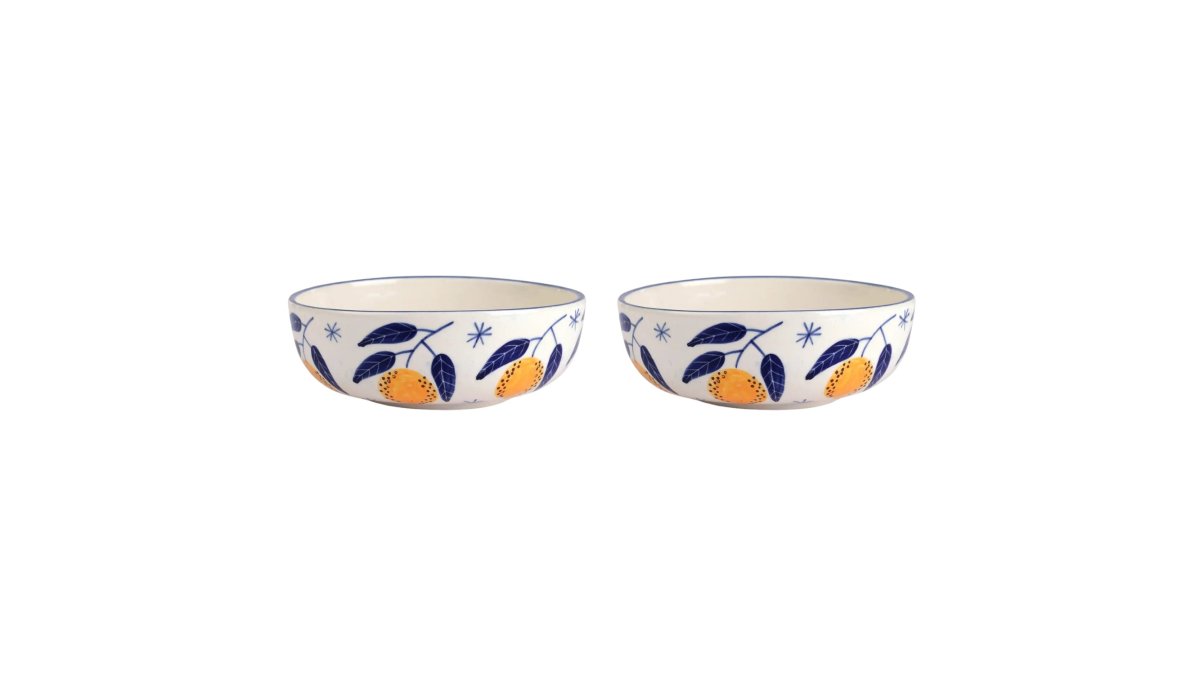
A hand-painted ceramic serving bowl in a glossy lemon glaze can anchor a neutral table, as our Italian Lemon Bowl does.

Mediterranean Decor Ideas by Room and Budget
Mediterranean decor ideas work best when you spend on the pieces you touch and save on the pieces you only see. That is the budget rule we give every client. Tabletop and lighting earn their cost because they are used daily. Accents can be fewer and quieter.
Tabletop and Dining
Start with one hand-painted collection and build outward. The LIMONI POSITANO: Dinner Plate is handcrafted and hand-painted in Deruta, Italy, and sets the tone at $98.00. The matching Salad Plate runs $88.00. For serving, the Serving Pasta Bowl is $198.00 and the Serving Oval Platter is $245.00.


Lighting and Ambience
Handwoven rattan pendants cast soft, filtered shadows. The Bastian Natural Rattan Pendant Light and Handwoven Rattan & Wood Nuella Pendant Light are catalog options for this look.
Accents and Greenery
The Terracotta Cachepot Jar in White Glaze, Short, at $60.00, pairs natural clay with a milky glaze.
Italian Lemon Bowl | Handpainted Ceramic Serving | 7" (Set of 2) →
Indoor-Outdoor Living: Materials That Survive Sun, Salt Air and Real Life
Indoor-outdoor living fails on materials, not on taste. Outdoor upholstery, woven fibers and glazed ceramics all behave differently under UV and humidity, and the pieces that last are the ones specified for it.
What Luxury Outdoor Brands Actually Specify
The brands that hold up in coastal and sun-heavy climates share a few specification habits. Most luxury outdoor furniture makers publish the following, and you should ask for them if a listing does not:
The Transitional Zone
For spaces that sit between indoors and out, a practical anchor such as the Turquoise and Moss Green Outdoor Doormat can help hold the palette. Rattan pendants are best used under covered areas.
Sourcing and Lead Times
Coastal customers should confirm delivery options and lead times with the retailer before ordering, since availability and shipping methods vary.
How to Identify Authentic Artisan Craftsmanship
Artisan craftsmanship is easier to judge when the maker names the workshop or region, the material is stated plainly, and the piece shows hand-work variation.
Italian ceramics from a named center like Deruta carry a recognizable tradition of hand-painting. Balinese rattan weaving and Indian stoneware are made by artisan hands. Catalog listings name origins where available.
Mixing High-End Home Decor Brands Into One Cohesive Room
Mixing home decor pieces works best when you repeat materials instead of matching product lines. Choose one dominant material family, then let a second and third appear in smaller doses. Stone, wood and woven fiber is the safest trio in this aesthetic.
Where most curated rooms fall apart is competing finishes. Brushed nickel beside aged brass beside matte black reads as indecision. Pick one metal and hold it. Layer textures within a single material family instead.
A cohesive room also needs a hierarchy: one statement piece, two supporting pieces, and the rest quiet. If everything in the room is a statement, nothing is.
| Room | Statement Piece | Supporting Pieces | Budget Approach |
|---|---|---|---|
| Dining | Hand-painted dinner plates | Salad plates, pasta bowl | Spend on the setting you use weekly |
| Living | Rattan pendant | Table lamp, cachepot | Spend on lighting first |
| Entry | Organic wood table | Doormat, ceramic accent | Spend on the surface you touch |
| Patio | Weather-ready mat | Covered lighting | Spend on durability, not decoration |
Build Your Mediterranean Retreat With Che Bella Casa
The hardest part of this aesthetic is not knowing what you like. It is sourcing pieces that hold up to the standard you just read, in one place, without hunting across a dozen vendors and hoping they coordinate.
That is what we built Che Bella Casa for. Che Bella Casa offers a curated collection of luxury home décor inspired by Mediterranean coastlines and European countryside estates, with many furniture pieces made to order. Pieces are chosen for artisan traditions and quality craftsmanship, to turn an everyday space into a beautifully lived-in retreat.
If you are mid-renovation and need pieces that work together, explore the Che Bella Casa collection and subscribe to our emails for updates.
Frequently Asked Questions
What is modern Mediterranean decor?
Modern Mediterranean interior design keeps the warmth of the coast but strips out heavy ornament. You will see limewashed or plaster-effect walls, natural materials like rattan, terracotta and stone, and a palette of warm neutrals with one or two sun-washed accents. Furniture lines are cleaner, textiles are lighter, and handcrafted pieces do the decorative work instead of pattern-on-pattern layering. The result reads calm and airy rather than themed, which is why it suits both coastal homes and inland properties.
Which materials work best for a refined Mediterranean interior?
Ceramic, terracotta, natural rattan, solid wood, linen and stone carry the look without tipping into kitsch. Look for hand-painted ceramics with visible brushwork, rattan woven over a metal frame for structure, and glazed terracotta that shows slight variation from piece to piece. Avoid high-gloss finishes and printed patterns that mimic handwork. Materials should feel tactile when you touch them, and small irregularities are a sign of artisan production rather than a defect.
What colors create a Mediterranean-inspired home?
Start with a Mediterranean color palette of warm whites, sand, oatmeal and soft greige for walls and large upholstery. Layer in sun-washed accents: lemon yellow, olive green, faded terracotta and a muted sea blue. The 3 color rule helps here, keeping to roughly 60 percent neutral, 30 percent secondary tone and 10 percent accent so the room stays calm. Keep saturated shades to smaller pieces like ceramics, cushions or a single statement light.
How do I choose luxury home decor that feels timeless?
Buy fewer pieces and check how each one is made. Hand-painted ceramics from a named workshop, hand-woven rattan lighting and glazed terracotta all age well because the finish is integral to the material, not applied on top. Ask where an item is made and by whom, confirm care instructions, and favor shapes that are simple enough to survive a change of sofa or wall color. A hand-painted dinner plate chosen for its craftsmanship beats several trend pieces that may date quickly.
How can I make Mediterranean decor feel more modern?
Limit the palette to two or three tones, choose cleaner silhouettes, and let one handcrafted piece lead each vignette. Pair a wavy-rim ceramic plate with plain linen and matte flatware rather than more pattern. Swap heavy drapery for light linen, use open-weave pendant lighting instead of shaded lamps, and keep decorative accessories to a few large objects instead of many small ones. The craftsmanship stays; the clutter goes.
The challenge is real: most "Mediterranean" décor on the market is a print, not a craft. We solve it by sourcing pieces with named origins, honest materials and hand-work you can see. Browse our curated luxury home décor, subscribe to our emails for new arrivals, and let us help you build the retreat you actually want to live in.
