

How to Style Mediterranean Home Decor: 2026 Guide
Table of Contents
- What You'll Need Before You Start
-
How to Style Mediterranean Home Decor: 7 Steps
- Step 1: Anchor the Room with a Neutral Base
- Step 2: Layer in Natural Materials and Textures
- Step 3: Choose a Mediterranean Color Palette for Homes
- Step 4: Add Essential Mediterranean Decor Elements
- Step 5: Get the Lighting and Sun-Filled Feel Right
- Step 6: Connect Indoors and Outdoors
- Step 7: Edit and Style the Finishing Touches
- Modern Mediterranean Interior Design: What to Keep and What to Skip
- Regional Sub-Styles: Greek vs. Italian vs. Spanish
- Small-Space and Budget-Friendly Mediterranean Styling
- Common Mistakes to Avoid
- Frequently Asked Questions
Last Updated: September 23, 2026
What You'll Need Before You Start
Gather foundational pieces first: a neutral base, a few natural materials, and a clear color direction will carry you further than any statement piece.
- A neutral base layer. Limewash paint, a warm white wall, or a plaster-effect finish gives everything else room to breathe.
- Two or three natural materials. Terracotta, raw wood, rattan, linen, or unglazed ceramic.
- A defined color palette. Warm earth tones with one or two muted accents.
- A measuring tape and a floor plan sketch. Mediterranean styling is about proportion, not volume.
- A budget ceiling. A limit prevents the slow accumulation of pieces that don't cohere.
How to Style Mediterranean Home Decor: 7 Steps
You can style Mediterranean home decor in seven steps: anchor the room with a neutral base, layer natural textures, choose an earth-toned palette, add essential decor elements, get the lighting right, connect indoors with outdoors, and edit the finishing touches.

Step 1: Anchor the Room with a Neutral Base
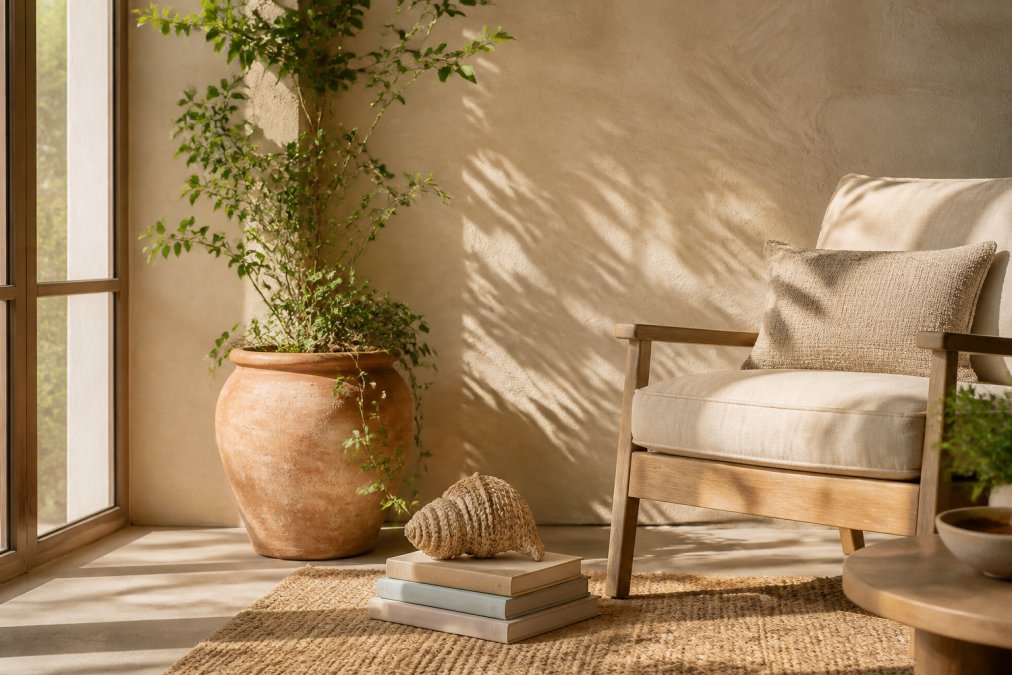
Start with walls and floors, since everything sits on top of them. A limewash finish or warm off-white paint gives the soft, chalky backdrop that defines the Mediterranean look; skip anything glossy or cool-toned. Floors should stay in the same family: warm wood, natural stone, or ceramic tile with visible variation. A jute rug adds texture without competing with the architecture.
Step 2: Layer in Natural Materials and Textures
Mediterranean rooms mix materials that age well: terracotta, wrought iron, raw timber, rattan, and linen all develop a patina. Aim for contrast within a narrow range, a matte terracotta vessel beside a smooth ceramic bowl beside a woven rattan handle creates interest without a new color. Textural layering, not color variety, makes these rooms feel collected rather than decorated.
Step 3: Choose a Mediterranean Color Palette for Homes
The Mediterranean color palette for homes stays close to the coastline: chalky white, warm sand, clay, olive, faded terracotta, and a muted blue for coastal influence. Keep the base neutral and let one or two accents do the work. A muted scheme reads as more sophisticated than a bright one; use stronger tones in small doses, a single ceramic piece or cushion, rather than across a whole wall.
Step 4: Add Essential Mediterranean Decor Elements
The essential Mediterranean decor elements are fewer than most people expect: an arched doorway or mirror, exposed wooden beams where possible, handcrafted ceramics, wrought iron accents, and plenty of indoor plants. Organic shapes matter, rounded silhouettes, irregular rims, and hand-thrown pottery signal handcrafted quality, while mass-produced pieces with uniform edges flatten the look.
Step 5: Get the Lighting and Sun-Filled Feel Right
Lighting should feel soft and warm, never clinical. Layer three sources: ambient light from a central fixture, task lighting from a table lamp, and accent light from candles or a floor lamp. Avoid cool-white bulbs; if your space lacks natural light, a large mirror opposite the brightest window bounces what you have and makes the room feel sun-drenched.

Step 6: Connect Indoors and Outdoors
Indoor-outdoor living is central to the Mediterranean approach, even in a small space. Treat a balcony, patio, or large window as an extension of the room, and keep materials consistent across the threshold: the same terracotta, rattan, and linen. A planter that works inside should work on the patio too, making the transition feel intentional.
Step 7: Edit and Style the Finishing Touches
The final step is subtraction. Walk through the room and remove anything that doesn't earn its place. A clutter-free surface reads as more luxurious than a full one.
| Step | What to Do | Time Needed | Frequency |
|---|---|---|---|
| 1. Neutral base | Paint walls, choose flooring | 1-2 weekends | Once |
| 2. Natural materials | Add terracotta, wood, rattan | 1 afternoon | As collected |
| 3. Color palette | Define 3-4 earth tones | 1 hour | Once |
| 4. Decor elements | Arches, ceramics, plants | 2-3 hours | Seasonal |
| 5. Lighting | Layer 3 light sources | 1 hour | Once |
| 6. Indoor-outdoor | Match materials across threshold | 1-2 hours | Seasonal |
| 7. Edit | Remove, rearrange, restyle | 30 minutes | Monthly |
Modern Mediterranean Interior Design: What to Keep and What to Skip
Keep:
- Limewash and plaster walls. The chalky, mottled surface is the single most recognizable signal of the style. A flat matte finish in warm white or soft sand does more than any accessory.
- Natural stone and warm wood. Travertine, limestone, and terracotta tile on floors; oak, olive, or reclaimed pine on furniture. These develop patina instead of showing wear.
- Linen and cotton upholstery. Slipcovered sofas and loose cushion covers in oatmeal, flax, or undyed linen keep the room breezy rather than formal.
- Arched details. A rounded doorway, an arch-top mirror, or a curved headboard softens the hard lines modern furniture introduces.
- A restrained neutral palette. Warm white, sand, clay, and one muted accent (olive, faded terracotta, or dusty blue).
Skip:
- Heavy dark furniture. Mahogany and espresso finishes read as traditional-formal, not modern-Mediterranean.
- Ornate wrought ironwork. Scrollwork fights the clean lines that define the modern version.
- Saturated wall colors. Deep reds, mustard yellows, and bright blues belong to a different era of the style.
- Matching furniture sets. A room where every piece came from the same collection looks showroom-flat. Mix eras and finishes.
- Themed accessories. Ship wheels, faux olive branches in plastic, and mass-produced "Tuscan" ceramics undermine the material honesty the style depends on.
The common mistake is treating "Mediterranean" as a theme rather than a set of material choices. A room with the right materials and a restrained hand always looks more convincing than one with themed accessories.
Regional Sub-Styles: Greek vs. Italian vs. Spanish
Greek, Italian, and Spanish Mediterranean styles share a material vocabulary but differ in palette and mood. Knowing which one you're drawn to prevents a confused room.
Clam Shell Candle | Minimalistic →
Small-Space and Budget-Friendly Mediterranean Styling
Most Mediterranean styling guides assume a villa with arched doorways and a courtyard. You don't need square footage or a large budget, you need to know which moves carry the most visual weight per dollar and per square foot.
Small-Space Mediterranean Styling
The core principle is scale, not quantity. A small room styled with three well-proportioned pieces reads as more Mediterranean than one packed with ten small ones.
Room-by-room moves:
- Living room. Choose one low-profile sofa in a light linen or cotton slipcover instead of a bulky sectional. A single arched floor mirror opposite the brightest window doubles the light and adds the architectural curve the style depends on. One large terracotta planter with a tall plant (olive, fig, or rubber tree) gives vertical presence without eating floor space.
- Bedroom. A linen duvet in oatmeal or undyed flax, two matching ceramic bedside lamps, and a single woven jute rug at the foot of the bed. Skip the heavy upholstered headboard; a simple arched or rounded one in a light fabric keeps the room airy.
- Kitchen. Open shelving in raw wood or warm white, a few hand-thrown ceramic bowls, and a single terracotta utensil crock. If you can't change the backsplash, a peel-and-stick zellige-look tile in a single glaze is a low-commitment upgrade.
- Bathroom. A linen shower curtain, a small terracotta tray for soaps, and a single arched mirror. Warm-white bulbs in the vanity fixture make more difference than any accessory.
Budget-Friendly Mediterranean Styling
Focus your spending on the pieces you'll touch and see daily. These carry more visual weight per dollar than a room full of small accessories.

Where to spend:
- A good ceramic vessel. A hand-thrown vase or bowl in a matte glaze anchors a shelf or table. One piece, not five.
- A quality linen cushion or two. Linen softens a room instantly and improves with washing.
- A well-made candle in a terracotta or ceramic holder. The warm light and the material both do work.
- A single natural-fiber rug. Jute or seagrass in a neutral tone grounds the room and adds texture underfoot.
Where to save:
- Paint and limewash. A gallon of limewash or warm-white matte paint is one of the highest-impact, lowest-cost changes you can make. It resets the entire room.
- Plants. A $15 olive or fig sapling in a $20 terracotta pot delivers more Mediterranean signal than most decor.
- Textiles. Thrifted or discount linen curtains, cotton throws, and jute runners cost a fraction of designer versions and read the same at a distance.
- Hardware. Swapping cabinet knobs and drawer pulls for simple aged-brass or matte-black versions is a low-cost way to shift a kitchen or bathroom toward the style.
Sustainable Sourcing as a Budget Strategy
Sustainable sourcing isn't just an environmental choice, it's often the cheaper one over time. Natural materials like terracotta, linen, jute, and solid wood age well and can be repaired rather than replaced: a solid-wood stool can be sanded and re-oiled, a particleboard version cannot. Handcrafted pieces hold their appearance far longer than mass-produced alternatives, meaning fewer replacements and lower long-run cost.
When sourcing, look for materials that are:
- Repairable. Solid wood over veneer, natural stone over composite, linen over polyester blends.
- Locally or regionally made. Shorter shipping distances usually mean lower cost and lower emissions.
- Unfinished or naturally finished. Oiled wood, unglazed terracotta, and undyed linen avoid chemical finishes that off-gas and wear unevenly.
Common Mistakes to Avoid
The most common Mediterranean styling mistakes come from over-application: too many colors, too many accessories, and too little attention to material consistency.
- Mixing too many regional palettes. Pick Greek, Italian, or Spanish as your anchor and stay within its material range.
- Buying accessories before the base. Walls and floors first, always.
- Using cool-toned lighting. It undermines every warm material in the room.
- Filling every surface. Negative space is part of the aesthetic.
- Choosing uniform, mass-produced pieces. Irregularity is the signature of handcrafted work.
Frequently Asked Questions
What is the 3-5-7 rule in decorating, and does it work for Mediterranean home decor?
The 3-5-7 rule is a styling guideline for arranging accessories in groups of three, five, or seven items to create visual balance. It works well for Mediterranean home decor because the style favors collected, layered vignettes rather than symmetrical sets. Try grouping a terracotta container, a woven seashell sculpture, and a small candle on a console, then vary heights and textures so the arrangement feels organic instead of staged.
What are the core colors for a Mediterranean color palette for homes?
A Mediterranean color palette for homes usually starts with a neutral base like warm white, cream, or soft beige, then adds earth tones such as terracotta, clay, olive, and muted gold. Blue appears as an accent, from deep cobalt to soft coastal blue. Keep the base calm and let one or two accent colors carry the warmth. Muted color schemes read more authentic than bright, saturated combinations.
What materials are essential for an authentic Mediterranean look?
Natural materials do most of the work: terracotta, limewash, natural stone, wrought iron, warm woods, linen upholstery, jute rugs, and ceramic tiles. Handcrafted pieces with visible patina, such as a terracotta planter with rattan handles, add the rustic elegance that mass-produced decor rarely captures. Mix at least three textures in every room so the space feels tactile rather than flat.
How can I incorporate Mediterranean style into a small living space?
Focus on a minimalist backdrop and fewer, larger pieces. Choose a light limewash or warm white wall, one arched mirror or doorway detail, and a single statement piece like a terracotta planter or a woven sculpture. Use vertical interest with indoor plants and sheer linen curtains to suggest breezy, indoor-outdoor living without crowding the floor plan. Clutter-free styling makes small rooms feel larger and calmer.