

Curated Home Decor Collections for Renovations
Table of Contents
- Why Curated Home Decor Collections Solve the Renovation Finishing Problem
- How to Style a Renovated Home With Curated Collections
- Curated Home Decor Collections Worth Building Around
- What Luxury Home Decor Online Shops Get Right About Sourcing
- Investment vs. Trend: Which Pieces Survive a Decade
- Maintenance and Longevity of Artisan Materials
- Common Mistakes When Styling a Renovated Home
- Frequently Asked Questions
Last Updated: September 25, 2026
Why Curated Home Decor Collections Solve the Renovation Finishing Problem
A renovation rarely fails because of the tile or the cabinetry. It stalls at the finish line, when the dust settles and the rooms sit empty, waiting for pieces that actually belong together. Curated home decor collections solve that problem by arriving as a considered group rather than a scatter of one-off purchases, so a renovated space feels finished instead of furnished.
How to Style a Renovated Home With Curated Collections
Styling a renovated home starts with restraint: fewer, better pieces placed with intention. The goal is a collected home, not a decorated one, and that means planning space and texture before buying a single object.
Start With Spatial Planning Before You Buy
Spatial planning is the practice of mapping where each piece will live before it is purchased. Measure the wall, the console, and the floor space first, then match decor to those dimensions.
- Photograph each empty room in daylight before you shop
- Note the largest uninterrupted wall for art and mirrors
- Mark floor zones where baskets or sculptural pieces will sit
- Check sightlines from doorways, not just from inside the room
Build Texture Layering Into Every Room
Texture layering means combining contrasting surfaces so a neutral room still feels rich. Wood against glass, woven fiber against smooth ceramic, matte against a quiet sheen.
Curated Home Decor Collections Worth Building Around
The most useful collections are built from a few categories that repeat across rooms. Art anchors the walls, trays and baskets carry function, and sculptural accents supply the personality that new construction lacks.
Wall Art and Mirrors: Anchoring the Visual Narrative
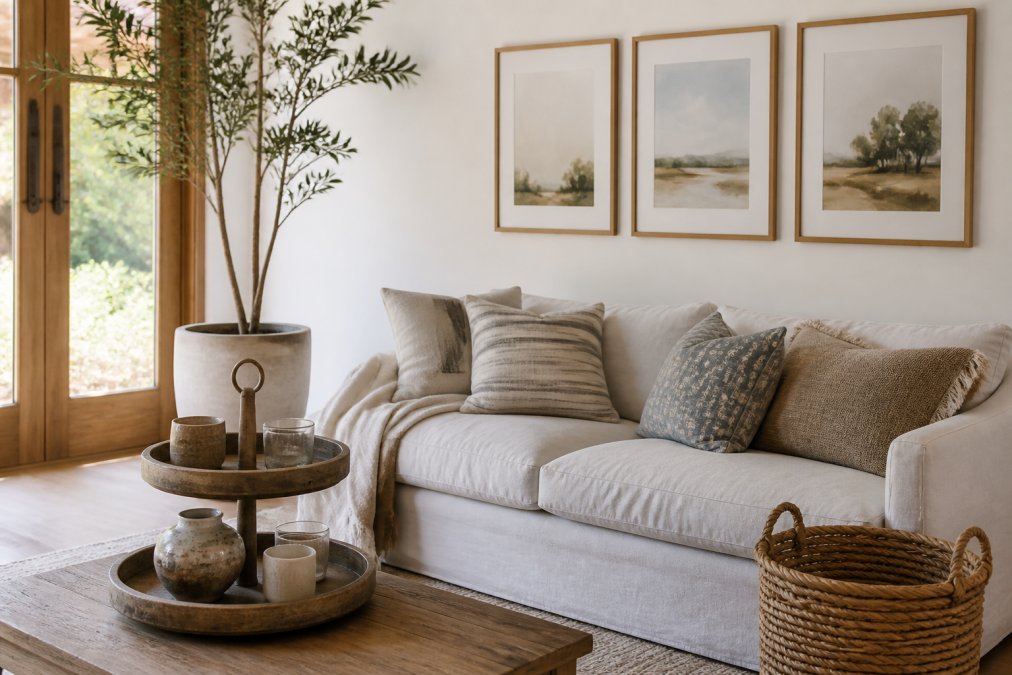
Wall art and mirrors do the heaviest lifting in a renovated room because they set the visual narrative before any furniture is placed. The Curated Gallery Wall Art Collection, Set of 3 ($74.99) pairs a minimalist portrait, a serene landscape, and an abstract piece, which gives a blank wall three points of interest without a single decision about matching frames.

Trays and Baskets: Functional Decor That Earns Its Space
Functional decor earns its footprint by doing two jobs at once. A tray corrals remote controls and candles; a basket hides throws and magazines while adding woven texture to a corner.
Storage options scale with the room:
| Piece | Price | Best Placement | Why It Works |
|---|---|---|---|
| Natural Water Hyacinth Baskets, Set of 3 | $40.00 | Living room corner, under console | Coastal weave, three sizes |
| Hand-Woven Storage Baskets, Set of 3 | $51.23 | Bedroom, bathroom, pantry | Lidded, breathable weave |
| Brodi Wicker Basket, Antique Finish | $143.00 | Entryway, beside a chair | Statement scale, vintage character |
Sculptural Accents: Small Pieces, Outsized Impact
Sculptural accents finish a room the way jewelry finishes an outfit. They cost the least and change the most, which is why they belong in any renovation budget.
What Luxury Home Decor Online Shops Get Right About Sourcing
The best luxury home decor online shops compete on sourcing, not on discounts. They publish where a piece comes from, name the material honestly, and let the maker's technique carry the value. But for a renovation, sourcing has a second job that most buyers overlook: the decor has to integrate with the finishes already specified in the build. A curated collection sourced well does both.
Sourcing Decor That Matches Your Renovation Phase
Renovations move through phases, demolition, rough-in, drywall, paint, trim, fixtures, punch list, and decor decisions land at different points in that sequence. The mistake is treating decor as a single purchase at the end. A more reliable approach is to source in three passes that map to the build.
- During finish selection (before paint): lock the metal family. If the kitchen faucet, cabinet pulls, and bath fixtures are satin nickel, avoid decor with bright polished brass or matte black hardware unless you intend a deliberate mixed-metal scheme. A single dominant metal plus one accent metal is the pattern most designers use.
- During trim and paint: choose the wood tone. Reclaimed barnwood trays and turned wood objects read warm; whitewashed or natural water hyacinth reads cooler. Match the decor wood tone to the floor or the cabinetry, not to both.
- After punch list: layer in textiles, art, and sculptural accents, which are the only categories safe to buy once the room is finished because they do not compete with fixed surfaces.
Sustainable Sourcing Signals That Hold Up
Sustainable sourcing is the clearest signal of a serious retailer, but the term is loose. Concrete signals to look for:

- Named material and origin. "Water hyacinth, woven in Southeast Asia" tells you more than "natural fiber."
- Reclaimed or salvaged inputs. Reclaimed barnwood and salvaged metal carry a documented second life, which is verifiable in a way that "eco-friendly" is not.
- Hand-layered or hand-woven construction. Paper mâché layered by hand and baskets woven by hand show irregular edges and slight weight variation, signs of a maker, not a mold.
- Repairability. A basket with a woven rim can be re-stitched; a glued composite cannot.
Where to Shop and What to Ask
When evaluating a luxury home decor online shop, ask three questions before ordering: Does the listing name the material and the maker or region? Is the finish described as sealed, oiled, or raw? What is the return window on oversized or fragile pieces? Retailers that answer all three in the product page are the ones whose collections will survive the renovation rather than fight it.
Investment vs. Trend: Which Pieces Survive a Decade
Investment pieces share three traits: neutral color, honest material, and a form that does not reference a single season. Trend pieces usually fail at least two of those tests. But "buy timeless" is advice, not a method. Here is a framework you can actually apply before you spend.
The Four-Question Test
Run every candidate piece through these four questions. A piece that answers yes to three or more is an investment; two or fewer is a trend.
- Can you describe it without naming the year you bought it? A woven basket, a brass-framed mirror, and a set of framed artworks pass. A novelty lamp or a slogan print rarely does.
- Does it hold up to a material swap? If the room's paint color changed, would the piece still work? Neutral color and honest material survive a repaint; a piece keyed to one wall color does not.
- Is the material repairable or refinishable? Solid wood can be sanded and re-oiled. Cast iron can be re-sealed. Paper mâché can be dusted but not washed. Composite and veneer usually cannot be repaired at all.
- Does the form appear in design catalogs from multiple decades? A turned-wood object, a two-tiered tray, and a freestanding mirror are forms that recur. A shape tied to one trend cycle does not.
Cost-Per-Year Math
The practical test for a renovation budget is cost per year of use, not sticker price. A $99.99 mirror that lasts ten years costs about $10 per year. A $30 trend accent that looks dated in two years costs $15 per year and then has to be replaced. The cheaper piece is often the more expensive one.

Apply the same math to categories:
- Buy once: mirrors, large art, woven storage, sculptural metal. These are the anchors; they set the palette and rarely need replacing.
- Buy carefully: textiles, which fade and wear faster and are the first category to show a trend cycle. Choose neutral tones and natural fibers.
- Buy freely: small accents under $50 that refresh a shelf. These are the pieces where a trend is fine because the cost per year is low and the swap is easy.
What Renovation Budgets Usually Get Wrong
A common pattern is to spend the renovation budget down to zero on fixed work and then fund decor from whatever is left, which forces trend purchases. A more durable approach is to reserve a decor line item during the planning phase, most practitioners suggest setting it aside before construction starts, so the anchor pieces are chosen with the finishes rather than after them.
Maintenance and Longevity of Artisan Materials
Artisan materials last decades when they are maintained on their own terms. Natural fiber, brass, paper mâché, and cast iron each have one or two habits that keep them looking right.
Common Mistakes When Styling a Renovated Home
Most styling mistakes come from buying too fast and placing too symmetrically. New construction is already symmetrical, and decor should break that grid rather than repeat it.
Other frequent errors:
- Filling every surface, which creates visual clutter instead of curated atmosphere
- Ignoring scale, so small objects disappear against tall ceilings
- Matching every finish, which flattens a room into one note
- Skipping spatial planning and then returning half the order
Frequently Asked Questions
What are the benefits of buying curated home decor collections?
Curated collections remove the guesswork from styling a renovated space. Instead of hunting through individual items and hoping they match, a curated set arrives with a cohesive aesthetic already built in. The Curated Gallery Wall Art Collection, Set of 3, for example, pairs a minimalist portrait, a serene landscape, and an abstract piece so the arrangement works together from day one. Collections also simplify budgeting because you know the total cost upfront, and they reduce the risk of visual clutter from mismatched impulse buys.
How do you choose a cohesive decor theme for a home renovation?
Start with your renovation's fixed finishes: flooring, countertops, and wall color. Those set the material palette. Then choose decor that echoes one or two of those tones and introduces contrast through texture. If your renovation leans warm and neutral, artisan pieces in natural wood, aged white, and antique brass will feel intentional. A curated home decor collection makes this easier because the pieces are already edited to share a design narrative, so you are layering rather than starting from scratch.
How do you mix artisan decor with modern renovation finishes?
Contrast is the tool. Sleek quartz counters and flat-panel cabinetry benefit from handcrafted pieces that add warmth and irregularity. A hand-woven wicker basket with an antique finish, or paper mâché bowls with a textured aged patina, soften hard modern surfaces. Keep the color palette tight, usually two or three neutral tones, and let texture do the work. That balance keeps a renovated room from feeling like a showroom and gives it the lived-in quality that artisan-made objects bring.
What is the difference between staged decor and curated home decor?
Staged decor is designed to photograph well and sell a property. It often uses generic, mass-produced pieces chosen for broad appeal. Curated home decor is chosen for the people who actually live there. It reflects a point of view, favors artisan-made and vintage finds, and holds up to daily use. A staged room looks finished but impersonal. A curated room looks collected over time, with statement decor and functional pieces that carry meaning and survive trends.
What is the 3-5-7 rule in decorating?
The 3-5-7 rule is a styling guideline for arranging objects in odd-numbered groups: three items for a small vignette, five for a medium surface, and seven for a larger display like a mantel or shelf. Odd numbers create visual tension that feels more natural than symmetrical pairs. When applying it, vary height and material so the group does not read as flat. A wood chain, a paper mâché bowl, and a small ceramic vase make a simple three-piece arrangement that works on almost any console.
Finishing a renovation is a design problem, not a shopping problem, and it is the stage most homeowners underestimate. Che Bella Casa curates luxury home decor built for exactly this moment, with artisan traditions, made-to-order furniture, and Mediterranean and European countryside influences that hold their character for years. Subscribe to our emails to see new collections as they arrive and finish your renovation with pieces chosen to belong together.