

Best Places to Buy Artisan Ceramics: 2026 Guide
Table of Contents
- What Makes Artisan Ceramics Different
- How to Identify Quality Artisan Ceramics
- Where to Find Authentic Handmade Pottery Online
- Artisan Pottery Care Guide for Long-Lasting Pieces
- Top Picks from a Curated Ceramic Collection
- Matching Artisan Ceramics to Your Space and Budget
- Conclusion
- Frequently Asked Questions
Last Updated: September 21, 2026
What Makes Artisan Ceramics Different
Artisan ceramics are one-of-a-kind pieces shaped, glazed, and fired by an individual maker rather than stamped out on a factory line, which is why no two are identical. At Che Bella Casa, we've built our ceramics collection around hand-sculpted forms, hand-painted glazes, and small-batch production.
How to Identify Quality Artisan Ceramics
Most buying guides tell you to "look for imperfections." That advice fails the moment you're staring at a listing photo. What actually separates artisan work from slip-cast production is a set of physical tests you can run in person or infer from good product photography. This is the verification layer most marketplace listings never give you.
Learn the Four Clay Bodies First
You cannot judge authenticity without knowing what you're looking at. Nearly every piece you'll encounter falls into one of four categories:
- Earthenware, fired at lower temperatures (roughly 1,700-2,100°F). Porous, chips more easily, and typically needs a glaze to be watertight. Common in decorative planters and terracotta-style pieces.
- Stoneware, fired higher (around 2,100-2,400°F). Dense, durable, chip-resistant, and the default body for most functional artisan dinnerware and mugs.
- Porcelain, fired highest (2,300-2,600°F). Fine-grained, translucent when thin, and rings almost like a bell when tapped. Harder to throw, which is why hand-thrown porcelain commands a premium.
- Slip-cast, not a clay body but a production method. Liquid clay (slip) is poured into a plaster mold, so every unit is identical. This is how most mass-market "handmade-looking" ceramics are made.
The Five Physical Tests
1. Mold lines and seam marks. Slip-cast pieces carry a faint raised line where two halves of the mold met, usually running vertically down the side or along the handle. Run a fingernail across it. A wheel-thrown piece has no seam, it has throwing rings, concentric ridges on the interior that spiral outward from the center.
Red Flags That Survive a Second Look
- Identical duplicates across an entire inventory. If twenty listings share the exact same silhouette, glaze pattern, and dimensions, you're looking at one mold.
- "Handmade" with no maker. The word is unregulated in commerce. It means nothing without a named studio.
- Prices that don't cover labor.
- Perfectly matched sets. Real artisan dinnerware sets are matched by eye, not by mold. Slight variation between plates is normal; identical plates are not.
Ask the Seller Three Questions
Before you buy from any source, send these. The answers tell you more than any product photo:
- "What clay body is this, and what temperature was it fired to?" A real studio answers in seconds. A reseller deflects.
- "Is this wheel-thrown, hand-built, or slip-cast?" Hand-built means coil, slab, or pinch construction, also legitimate artisan work, just a different technique.
- "Who is the maker, and where is the studio?" If they can't name a person or a place, you're buying from a warehouse.
Where to Find Authentic Handmade Pottery Online
There are three real channels for buying artisan ceramics online, and they differ in ways that affect both what you pay and what you can verify. Understanding the mechanics, not just the category names, is what separates a confident purchase from a gamble.
Direct-to-Artist: Buying From a Potter's Own Site
When you buy from an artist's personal website or studio shop, the maker keeps the full sale price minus payment processing (typically around 3% for card transactions). On a $120 bowl, that's roughly $116 to the potter instead of the $60-$85 they'd net after marketplace commissions.
That economics gap shows up in three places:
- Better clay and glaze materials. A potter netting more per piece can afford to work in porcelain instead of earthenware, or use a food-safe custom glaze instead of a commercial one.
- Made-to-order flexibility. Direct buyers can often request a specific dimension, glaze, or handle style before the piece is thrown. Marketplaces rarely allow this.
- Direct provenance. You're talking to the person who made it. You can ask about firing temperature, food safety, and care without a middleman guessing.
Curated Marketplaces: Vetted Selection, Higher Markup
Curated marketplaces and gallery-style retailers do the sourcing for you. A buyer or curator selects pieces from multiple studios, which means you get a cohesive collection rather than a random assortment, and you get a single checkout, consolidated shipping, and often a return policy.
Mass Marketplaces: The Authenticity Problem
General e-commerce platforms are where most buyers get burned. The same search results mix genuine studio work with slip-cast imports labeled "handmade."
How to Choose
| Channel | Typical Markup | Provenance | Best For |
|---|---|---|---|
| Direct-to-artist | None (processing fees only) | Strongest, you talk to the maker | Collectors, custom pieces, best value per dollar |
| Curated marketplace | 15-50% | Strong if vetted | Cohesive collections, single checkout, returns |
| Mass marketplace | Varies wildly | Weak to none | Bargain hunting with high verification burden |
A Practical Buying Sequence
- Start direct. Find 5-10 potters whose style you like and follow their shop-update schedules.
- Use curated sources for sets. When you need matching dinnerware or a coordinated collection, a vetted marketplace can simplify the process.
- Verify before you commit. Run the three seller questions from the identification section on any new source.
- Buy one piece first. Test a new source with a single small item before ordering a set.
This is where Che Bella Casa operates, as a curated source. Our ceramic decor is chosen for artisan traditions and quality craftsmanship, so you're not sorting through thousands of unrelated listings to find pieces that work together.
Ruyi and Peony Chinoiserie Porcelain Jar →
Artisan Pottery Care Guide for Long-Lasting Pieces
The rules for caring for ceramics are simple: avoid thermal shock, skip the dishwasher for hand-painted or porous pieces, and handle rims and handles with care.
Cleaning and Handling
Wash glazed stoneware and porcelain by hand in warm water with mild dish soap. A soft sponge is enough. Avoid abrasive pads, which dull glazes over time.
Display and Storage
Store pieces with felt pads or cloth between stacked items to prevent chipping. Keep decorative jars and planters out of direct, prolonged sunlight if the glaze is hand-painted, since UV exposure can fade pigments over years.
| Care Task | Frequency | Why It Matters |
|---|---|---|
| Hand wash with mild soap | After each use | Protects hand-painted glazes |
| Inspect rims and handles | Monthly | Catches small chips before they spread |
| Rotate display pieces | Seasonally | Prevents uneven UV fading |
| Bring planters indoors | Before first freeze | Prevents freeze-thaw cracking |
Top Picks from a Curated Ceramic Collection
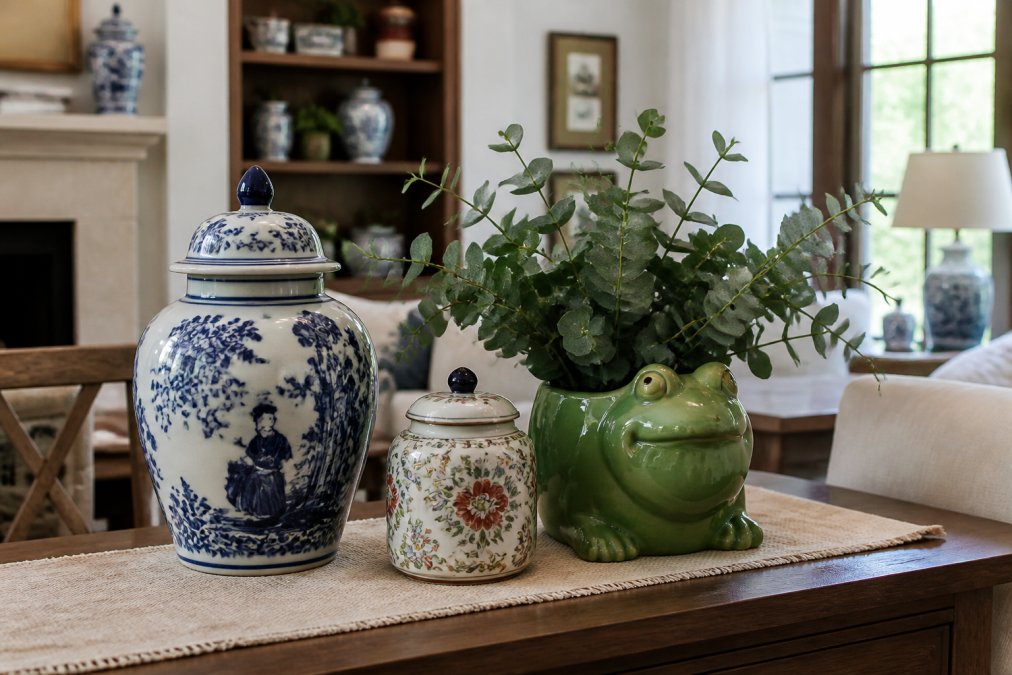
A curated collection saves you the guesswork of matching pieces across different studios. The strongest collections share a palette and a level of craftsmanship, so individual pieces layer together without looking assembled at random.
Matching Artisan Ceramics to Your Space and Budget
Match ceramics to your space by deciding three things first: the function, the palette, and the scale. A decorative jar anchors a console. A planter adds height to a patio. A canister earns its place on a countertop.
| Piece | Price | Best For |
|---|---|---|
| Floral Songbird Ceramic Storage Jar | $45 | Vanity, coffee station, small keepsakes |
| Blue Ceramic Chain-Textured Decorative Jar with Lid, 12" | $75 | Entryway or mantel display |
| Ruyi and Peony Chinoiserie Porcelain Jar | $95 | Console or sideboard anchor |
| Verdant Garden Ceramic Frog Planter | $115 | Indoor or outdoor greenery |
| Azure Bohemian 20-Piece Ceramic Dinnerware Set | $297 | Everyday dining and entertaining |
Conclusion
The hardest part of buying artisan ceramics isn't finding pieces. It's telling real handwork apart from good marketing, and that comes down to provenance, visible craft, and a source willing to name the maker.

Frequently Asked Questions
What should I look for when buying artisan ceramics online?
Look for clear photos of the actual piece, not stock images. Check for maker information, material details like stoneware or porcelain, and whether the glaze is hand-applied. Read the description for signs of hand-thrown or hand-sculpted work, such as slight variations in shape or surface. A reputable seller will list dimensions, care instructions, and return policy. If the listing feels vague or uses only generic terms, ask questions before buying. Authentic artisan ceramics often include a maker's mark or studio name on the base, which you can request to see.
How can I tell if ceramics are truly artisan-made?
Artisan-made ceramics show small irregularities that mass production cannot replicate: subtle differences in glaze pooling, slight asymmetries in form, and tool marks from the wheel or hand-sculpting. Look for a potter's mark or signature on the bottom. Mass-produced pieces are often perfectly uniform, with decals rather than hand-painted decoration. Ask about the firing process and clay body. If a seller cannot answer basic questions about how the piece was made, that is a red flag. Authentic handmade pottery online typically comes with a story about the artist or studio.
What is the best way to care for handmade ceramics?
Hand-wash artisan ceramics with mild soap and warm water, avoiding harsh abrasives or sudden temperature changes. Most stoneware and porcelain are dishwasher-safe, but hand-washing preserves the glaze and decoration longer. Do not use them in the microwave if they have metallic accents or delicate hand-painted details. For decorative pieces like lidded jars or planters, dust with a soft cloth. If the piece is outdoors, bring it inside during freezing temperatures to prevent cracking. Always follow any specific care instructions provided by the maker.
How do artisan ceramics differ from mass-produced dinnerware?
Artisan ceramics are made in small batches, often by a single potter or studio, using traditional techniques like wheel-throwing or hand-sculpting. Each piece is unique, with variations in glaze, shape, and surface decoration. Mass-produced dinnerware is made in factories using molds and machines, resulting in identical pieces. Artisan work often uses higher-quality clay bodies and food-safe glazes, and the firing process is carefully controlled. The price reflects the time, skill, and materials involved. Mass-produced items cost less but lack the unique character of handmade pottery.
Are there specific regions known for high-quality artisan pottery?
Yes, certain regions have long-standing pottery traditions. In the United States, areas like Seagrove, North Carolina, and the Ohio River Valley are known for studio pottery. Internationally, regions in Japan, Portugal, Italy, and Mexico have distinctive ceramic heritages. However, you do not need to travel to find authentic pieces. Many artisans sell directly online or through curated marketplaces. When buying, look for the maker's location and training. A piece made in a region with a strong pottery tradition often reflects local clay and techniques passed down through generations.