

Best Luxury Home Decor Online Shops: 2026 Guide
Table of Contents
- What Separates the Best Luxury Home Decor Online Shops From the Rest
- How to Source Luxury Home Decor Without Getting Burned
- Investment Value: Which Pieces Actually Hold Their Worth
- Luxury Home Accessories Online: Statement Pieces That Anchor a Room
- Curated Collections: Building a Cohesive Luxury Home
- Sustainable and Artisanal Luxury: What Certifications and Practices to Look For
- Frequently Asked Questions
Last Updated: September 20, 2026
What Separates the Best Luxury Home Decor Online Shops From the Rest
The best luxury home decor online shops distinguish themselves through verifiable craftsmanship, transparent sourcing, and pieces built to outlast trends. Che Bella Casa built its collection around that standard, sourcing from artisan traditions rather than mass-production lines.
Craftsmanship and Material Provenance
Material provenance is the documented record of where a piece's raw materials came from and how they were worked. It answers the question "why does this cost more than the version down the street?"
Authenticity Verification and Sourcing Transparency
Authenticity verification is the practice of confirming that a piece is genuinely what the seller claims, through documentation, maker identification, or material testing. Ask any retailer for the maker's name and origin before you buy.
How to Source Luxury Home Decor Without Getting Burned
Sourcing luxury home decor successfully comes down to asking the right questions before money changes hands. The Federal Trade Commission's guidance on online shopping outlines your rights on returns, shipping, and misrepresentation, and it is worth reading before any high-value purchase.
Questions to Ask Before You Buy
- Who made this piece, and in what country?
- What exactly is it made from? Ask for percentages, not adjectives.
- What are the real dimensions, and will they fit my space?
- What is the return window, and who pays return shipping?
- Is this made to order, and what is the production timeline?
- Does the finish vary from the photograph, and how much?
Investment Value: Which Pieces Actually Hold Their Worth
Most decor does not appreciate. A sofa is not a stock, and treating it like one is how people end up overpaying for "limited editions" that never resell. What luxury decor can do is hold value in three measurable ways: retain resale worth, avoid depreciation faster than comparable mass-market goods, and reduce replacement cost over a decade of use. Understanding which category a piece falls into is the difference between a purchase and an expense.
The Three Tiers of Decor Value
Tier 1, Appreciating assets. Hand-thrown ceramics by a named studio potter, signed limited-edition prints, and documented antique or estate pieces with provenance. These trade on the secondary market through auction houses, estate sales, and specialist dealers. Value depends on the maker's reputation, the piece's condition, and whether the original documentation survives.
What Actually Drives Resale Worth
Four factors move the needle more than anything else:
- Maker attribution. A named maker with a documented body of work resells. "Artisan-made" with no name attached does not.
- Material integrity. Solid teak, full-grain leather, and 45% bone-powder bone china can be repaired and refinished. Bonded leather and veneer cannot.
- Condition and originality. Original finish, original hardware, and no repairs outperform refinished pieces in most collecting categories.
- Documentation. Receipts, certificates of authenticity, and provenance files raise resale value and speed up authentication.
The Depreciation Math Most Shoppers Skip
A $4,500 top-grain leather Chesterfield that lasts twenty years costs about $225 per year of use. A $1,200 bonded-leather sofa replaced every four years costs $300 per year and ends up in a landfill four times over. The luxury piece is not just better made, it is cheaper per year, and it may still resell for a portion of its purchase price at the end.
Where to Verify Value Before You Buy
- Check completed auction listings for comparable pieces by the same maker.
- Ask the retailer whether the maker is documented and whether certificates of authenticity are provided.
- For antiques and estate pieces, request a condition report in writing before purchase.
- For high-value items, a third-party appraisal is worth the fee, it protects both the purchase price and any future insurance claim.
Luxury Home Accessories Online: Statement Pieces That Anchor a Room
Statement pieces work best when one object carries the visual weight of a space and everything else supports it. Three or four strong pieces across a home beat twenty forgettable ones.
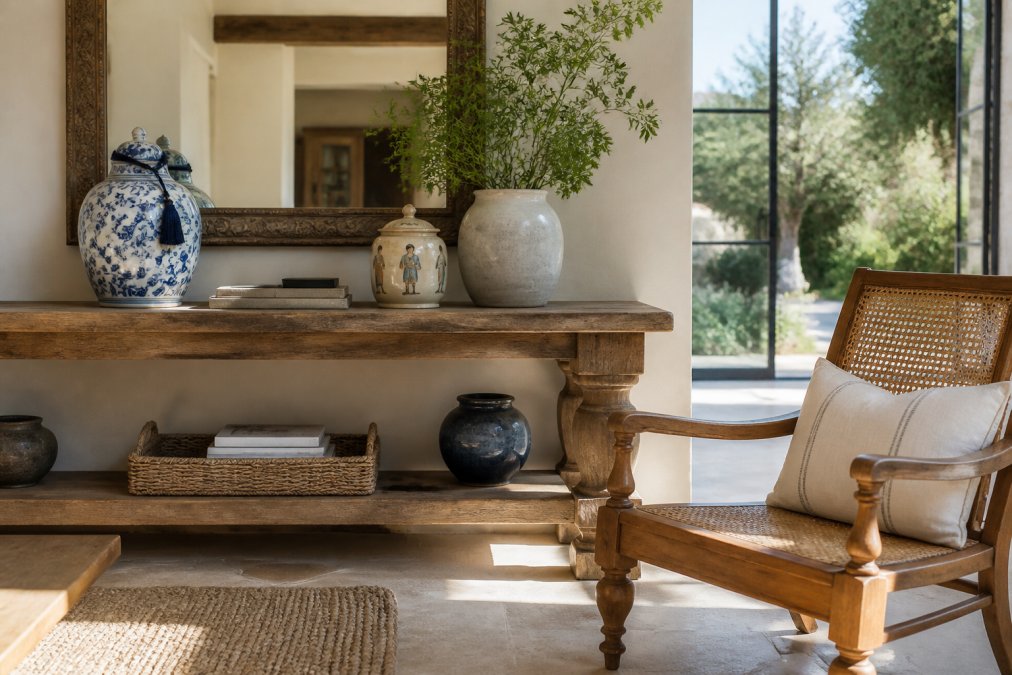
Chinoiserie Jars and Ceramic Accents
Chinoiserie jars bring old-world character to a console, shelf, or sideboard without demanding a full redesign. The Ruyi and Peony Chinoiserie Porcelain Jar ($95) pairs a blue-and-white peony motif with a sculpted ruyi-style lid and tassel accent.
Sculptural Furniture and Lounge Chairs
The Ravello Turned Wood Lounge Chair ($375) shows how a single piece can set a room's tone. A solid teak frame with woven cane inserts supports up to 250 lbs, and the contrast between wood and cane gives it a timeless focal point quality for dining spaces, offices, or living areas.

Curated Collections: Building a Cohesive Luxury Home
A curated collection is a coordinated group of pieces chosen to work together in color, material, and scale, so a room feels intentional rather than assembled at random. This matters most during a full renovation, when mismatched purchases show.
Dinnerware as the Foundation of a Collected Table
Dinnerware anchors more than a table; it sets the palette for the room. The Regency Garden Fine Bone China Dinnerware Collection ($175) works in traditional, French Country, and Chinoiserie-inspired interiors, and layers well with heirloom pieces and simple white serving ware.
Sustainable and Artisanal Luxury: What Certifications and Practices to Look For
"Sustainable" is the most abused word in home decor. A product page can print it without proving anything. The way to cut through it is to filter shops by third-party certification and documented sourcing, not by marketing language. This is the gap most competitor roundups skip: they list eco-friendly shops without telling you how to verify the claim.
Certifications That Actually Mean Something
- Forest Stewardship Council (FSC) certification, tracks wood and wood-derived products back to responsibly managed forests. Relevant for solid teak, oak, and walnut furniture, and for paper and packaging. Ask whether the certification covers the finished piece or only the raw lumber.
- U.S. Environmental Protection Agency's Safer Choice program, verifies cleaning and household products against ingredient safety criteria. Useful for candles, surface treatments, and finishes.
- Global Organic Textile Standard (GOTS), covers organic fiber content and processing for textiles, including cotton, linen, and wool used in upholstery and bedding.
- OEKO-TEX Standard 100, tests finished textiles for harmful substances. Common on bedding, throws, and upholstery fabrics.
- Fair Trade Certified, verifies labor and sourcing standards for artisan-produced goods. Relevant for handcrafted ceramics, textiles, and small-batch furniture.
A certification is only useful if you can name the certifying body and the scope. "Eco-friendly" with no acronym behind it is a mood, not a standard.
How to Filter Shops by Eco-Conscious Practice
Run every luxury shop through these five checks before you trust a sustainability claim:
- Certification page. Does the shop list specific certifications with issuing bodies, or does it use vague language like "responsibly sourced"? Specific beats sincere.
- Maker disclosure. Can the shop name the workshops and countries where pieces are made? Artisanal production is inherently more traceable than factory output.
- Material transparency. Are percentages and material origins listed (e.g., 45% bone powder in bone china, solid vs. veneered hardwood)?
- Repair and longevity policy. A shop that sells replacement parts or offers repair services is practicing sustainability in a way a marketing badge cannot fake.
- Packaging and shipping. Recycled or recyclable packaging and consolidated shipping reduce the footprint of an online purchase.
Artisanal Production as a Sustainability Strategy
The most credible sustainability story in luxury decor is not a certification at all, it is longevity. Hand-thrown ceramics, hand-joined hardwood furniture, and hand-woven textiles are made to be repaired, refinished, and passed down. That model directly opposes the replace-every-few-years cycle of mass-produced decor. When you buy artisanal, you are buying a longer service life, and that is the most measurable environmental benefit in the category.
A Quick Verification Checklist
| What to Check | Why It Matters | What to Ask |
|---|---|---|
| Certification | Separates claims from proof | Which body certified it, and what scope? |
| Material origin | Confirms real provenance | Which country, which maker? |
| Construction method | Predicts lifespan and repairability | Solid, joined, or veneered? |
| Repair policy | Signals real longevity commitment | Are replacement parts available? |
| Packaging | Reduces shipping footprint | Recycled or recyclable? |
| Return policy | Limits your risk | Who pays return shipping? |
Frequently Asked Questions
What is the best website for online home decor shopping?
The best luxury home decor online shops combine curation, transparency, and craftsmanship. Look for sites that name their artisans, explain materials, and offer detailed product dimensions. Che Bella Casa, for example, offers a curated selection of Mediterranean and European-inspired pieces, from hand-woven textiles to sculptural ceramics, with many furniture pieces made to order.
How do I identify high-quality craftsmanship when shopping for home decor online?
Examine material descriptions, construction details, and dimensions. Genuine top-grain leather, solid teak frames, and fine bone china with high firing temperatures signal durability. Ask about the maker, the region, and whether pieces are mass-produced or artisan-crafted. A 60-piece bone china set fired at high temperatures, for instance, resists chipping better than standard porcelain.
What are some reputable luxury home decor brands for high-end interiors?
Reputable brands prioritize artisan traditions, use quality materials, and provide transparent sourcing. Che Bella Casa sources pieces inspired by Mediterranean coastlines and European countryside estates, including made-to-order furniture and handcrafted ceramics. Their collections emphasize timeless design over trends, which helps ensure pieces remain relevant for years.
Where do interior designers shop for luxury furniture and accessories?
Designers often source from curated online shops that offer trade programs, detailed specifications, and cohesive collections. They look for pieces that work together, such as coordinated dinnerware sets or statement furniture like a Chesterfield sofa. Che Bella Casa offers curated collections and room sets, making it easier to build a unified look without hunting individual items.
What should I consider when buying investment pieces for the home?
Focus on materials that age well, timeless silhouettes, and artisan construction. Top-grain leather sofas develop character over time, while fine bone china and solid wood furniture hold up to daily use. Verify the return policy and warranty, and confirm dimensions before ordering. Pieces made to order often carry higher value because they are not mass-produced.
Choosing well takes more work than clicking "add to cart," and that is exactly the point. Che Bella Casa curates pieces built on artisan traditions and quality craftsmanship, from made-to-order furniture to hand-finished ceramics and bone china designed for daily use. Browse the collection, subscribe to our emails for new arrivals, and build a home that feels refined and inviting for years to come.